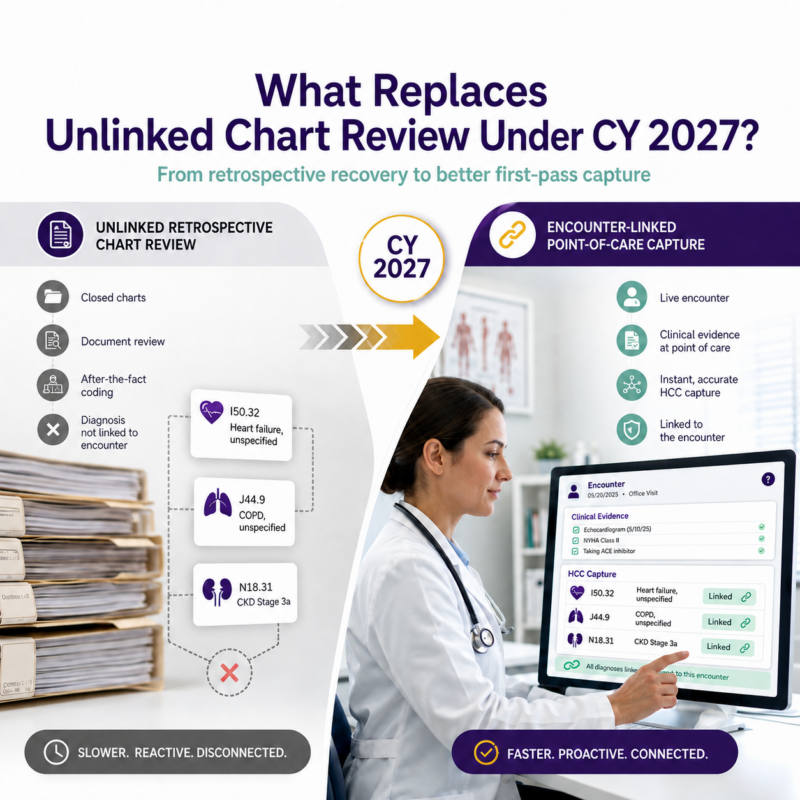
For years, retrospective chart review gave Medicare Advantage organizations another chance to find diagnoses after the patient encounter was over.
If an HCC surfaced later, plans could submit additional diagnosis information through a chart review record. In some cases, that record wasn’t linked to a specific encounter.
That changes in CY 2027.
CMS has finalized the exclusion of diagnoses from most unlinked chart review records, or CRRs, from risk score calculation. There is an exception for certain beneficiaries who move between Medicare Advantage organizations under different parent organizations, and the exclusion doesn’t apply to PACE organizations in the same way.
The important distinction is that CMS isn’t eliminating chart review. Plans can still submit eligible diagnoses through encounter data records and linked CRRs.
What changes is the value of a diagnosis that can’t be connected to an identifiable encounter.
For organizations that have relied heavily on unlinked retrospective capture, that creates a practical question: what does the workflow look like now?
At the submission level, EDRs and linked CRRs remain available. Operationally, though, organizations have a strong reason to move more HCC identification and documentation earlier, while the provider still has the clinical context needed to evaluate the condition.
That’s where point-of-care risk adjustment software becomes more important.
For non-PACE organizations, CMS will exclude diagnoses from most unlinked CRRs from CY 2027 risk score calculation.
CMS isn’t prohibiting organizations from submitting unlinked CRRs. The change is narrower: with the exception CMS created for certain MA switchers, diagnoses on those records generally won’t be used to calculate the risk score.
An unlinked CRR contains diagnosis information that isn’t associated with a previously submitted encounter data record. A linked CRR, on the other hand, connects additional diagnosis information to an identifiable encounter.
CMS has been clear about why that distinction matters. Risk-adjusted payment is supposed to reflect a beneficiary’s documented health status based on actual clinical encounters.
The scale of unlinked submissions helps explain the change.
CMS reviewed 88.8 million unlinked CRRs submitted in 2023 for 2024 payment and found that about 85% couldn’t be associated with any submitted encounter, even after matching on the beneficiary, billing provider, and dates of service within three days.
That doesn’t mean every one of those diagnoses was clinically wrong. It does show how often the diagnosis data couldn’t be connected to an encounter already in CMS’s system.
CMS is also excluding certain diagnoses from audio-only services in CY 2027. Organizations looking at their exposure should be paying attention to both changes. We cover them together in the three risk adjustment shifts defining 2027.
A chart review record lets a Medicare Advantage organization add or delete risk-adjustment diagnosis information.
The difference between a linked and unlinked CRR is whether the chart review points back to an encounter that has already been submitted.
A linked CRR connects additional diagnosis information to a specific encounter data record.
An unlinked CRR doesn’t identify a previously submitted EDR that the diagnosis should be associated with.
That distinction is important because CY 2027 isn’t the end of retrospective review.
CMS has also pointed out that an encounter data record isn’t necessarily the same thing as a traditional paid claim. If a clinical interaction doesn’t produce a traditional claim, the item or service may still need to be reported through encounter data.
So the policy isn’t “no retrospective diagnoses.”
It’s that, for most non-PACE organizations, diagnoses submitted through an unlinked CRR generally won’t contribute to the CY 2027 risk score.
There are really two answers.
From a submission standpoint, eligible diagnoses can still flow through encounter data records and linked CRRs. If additional diagnosis information needs to be associated with an encounter that’s already been submitted, a linked CRR remains available.
From an operational standpoint, organizations have a reason to rely less on finding everything after the fact.
The traditional workflow often looked like this: the visit happened, the chart closed, a retrospective team reviewed the record, and missed HCC opportunities were identified later.
That process doesn’t disappear in 2027. But if the organization depends on an unlinked CRR to turn those findings into risk-adjustment payment, there’s now much less room for recovery.
A stronger workflow brings more of the review forward. Relevant clinical information can be analyzed before or during the visit, potential HCCs can be surfaced with supporting evidence, and the provider can decide whether the condition is current and belongs in the documentation.
That doesn’t eliminate linked CRRs or retrospective review. It simply reduces how dependent the organization is on late recovery.
We’ve written more about that shift in moving from retrospective to prospective risk adjustment workflows.
Retrospective review still has plenty of value.
It can catch coding errors, identify unsupported diagnoses, find documentation gaps, surface missed opportunities, and show where provider education is needed.
What it can’t do is make an unlinked diagnosis count simply because the reviewer found more evidence.
If a condition was relevant but never adequately documented, a reviewer can’t go back and recreate the clinical decision-making that happened during the visit.
There may still be options. The organization may be able to connect appropriate diagnosis information to an existing encounter through a linked CRR, identify another eligible encounter, or follow an appropriate query process.
But those options depend on what actually exists in the record and encounter data.
The later the problem is found, the fewer clean options there may be.
That’s one reason organizations continue to struggle with HCCs that aren’t addressed until after the point of care.
It also changes the way risk adjustment technology should be evaluated. Finding potential diagnoses is useful. Finding them while there’s still an opportunity for the clinician to evaluate and document the condition is more useful.
Good risk adjustment software should help organizations identify relevant HCC opportunities early enough for someone to act on them without turning the patient visit into a coding exercise.
A few capabilities matter more as organizations reduce their dependence on unlinked retrospective capture.
Claims and prior diagnosis lists are valuable signals, but they don’t tell the whole story.
Clinical notes, medications, labs, prior diagnoses, and other structured and unstructured information can provide context that isn’t visible in claims alone.
Software that can bring those sources together gives the provider a better starting point for deciding whether a suspected condition deserves attention.
Timing matters.
A possible HCC identified months after the encounter becomes another item for a retrospective team to investigate.
The same clinical signal presented during the provider’s normal workflow can be evaluated alongside the rest of the patient’s information.
The provider can decide whether the condition is current, whether the evidence supports it, and whether it belongs in the note.
That’s one way point-of-care AI can support more accurate RAF capture.
A long list of HCC suspects isn’t useful if the provider has to search through years of chart history to understand why each one appeared.
The evidence behind the suggestion should be easy to see.
That could include relevant notes, labs, medications, prior diagnoses, or other information that helps explain why the condition was surfaced.
Software can identify a potential condition. It shouldn’t turn that suspect into a diagnosis on its own.
The provider still has to decide whether the condition is clinically supported and appropriate to document.
The goal isn’t to push more diagnoses into the chart. It’s to make it easier for the provider to see relevant information and document what was actually evaluated.
Every extra screen, queue, or inbox creates more work.
Point-of-care technology is much more useful when it works inside the clinical workflow instead of asking the provider to leave the EHR and complete a separate risk-adjustment process.
For organizations evaluating risk adjustment factor software, RAF impact still matters. But it shouldn’t be the only measure.
A better question is how much accurate capture happens during the normal clinical workflow and how much still has to be rescued later.
We look at that more closely in proving the ROI of risk adjustment beyond chart review.
Moving more risk-adjustment work upstream doesn’t mean asking physicians to perform their own manual chart review before every visit.
The software can analyze clinical information already in the patient’s record, including structured data and narrative documentation that would otherwise take someone time to review manually.
Potential HCC opportunities are then presented for review, along with the information that surfaced them.
The provider decides whether the condition is relevant and supported. If it is, it can be documented with the appropriate specificity as part of the clinical encounter.
That helps build stronger documentation at the source and reduces the amount of basic diagnosis capture that has to be handled later.
It also supports a cleaner encounter-based submission process, although the organization’s normal coding and encounter-data workflows still determine how that diagnosis ultimately reaches CMS.
We walk through the clinical side in more detail in closing HCC coding gaps at the point of care.
HCC Assistant is designed to move HCC review closer to the point of care.
It uses natural language processing to analyze structured and unstructured information in the patient’s chart, applies clinical logic to identify conditions that may need review, and surfaces those HCC opportunities inside the EHR.
Instead of discovering a possible condition only after the chart is closed, the provider can see the opportunity while working in the patient record, review the supporting evidence, and decide whether it should be documented.
HCC Assistant doesn’t replace CMS encounter-data requirements, and it doesn’t replace clinical judgment.
Its role is to reduce some of the dependence on finding clinically relevant information after the visit and trying to recover it later.
Point-of-care capture is only one part of the process.
HCC Validator adds a pre-submission validation layer by checking whether diagnoses have the documentation needed to support them. That gives organizations another opportunity to catch unsupported diagnoses before they move downstream.
For more on the provider side of documentation, see our guide to RADV documentation at the point of care.
No.
Retrospective work will still be needed to validate documentation, identify unsupported diagnoses, monitor coding accuracy, find recurring gaps, support two-way review, and prepare for RADV and other audits.
What’s changing is the role it plays.
Historically, organizations could lean on retrospective review as a major HCC recovery mechanism. A condition missed earlier could become a chart-review project later.
That workflow still has value, especially when a valid diagnosis can be associated with an eligible encounter.
But retrospective review is becoming more useful as a quality-control and improvement process rather than something the organization depends on to recover large amounts of risk through unlinked submissions.
If the same diagnoses keep getting missed at the point of care, retrospective review should help answer why.
Was the information buried in the chart? Was the provider never shown the relevant evidence? Was the documentation too vague? Was the condition no longer current?
Those answers can improve the next encounter instead of simply creating another recovery project.
That’s the idea behind moving toward a more proactive, audit-ready documentation culture.
RAF still matters. It just doesn’t tell the whole story.
Organizations should also understand how dependent they remain on retrospective capture.
Useful measures can include:
Those measures help answer a more useful question than “How much did we capture?”
They show where the work is happening and how much still has to be fixed later.
CMS is also changing MAO-004 reporting to reflect the CY 2027 diagnosis exclusions. Based on CMS’s July 2026 implementation guidance, plans should be preparing for reissued MAO-004 reports that show the effect of the new exclusions and for a new reason code identifying diagnoses disallowed under the unlinked CRR policy.
Those reports should give organizations a much clearer view of where their exposure sits before the CY 2027 Midyear run.
The diagnoses used for CY 2027 Midyear and Final risk scores come from 2026 dates of service, so the relevant encounters are happening now.
A practical starting point is to measure how much of the organization’s current workflow still depends on unlinked CRRs.
Which HCCs are showing up there? Which provider groups or markets generate the most volume? Which workflows consistently require retrospective recovery?
Then ask why.
Maybe the condition was buried in the chart.
Maybe the provider didn’t have the relevant evidence during the visit.
Maybe it appeared on the problem list but wasn’t evaluated.
Maybe the documentation wasn’t specific enough.
Or maybe the organization has simply become accustomed to letting retrospective teams find things later.
Each problem calls for a different fix.
There is still time to submit eligible CY 2027 diagnosis data. CMS’s current schedule lists March 5, 2027 as the submission deadline for the CY 2027 Midyear run and January 31, 2028 for the CY 2027 Final run.
But those submission deadlines shouldn’t be confused with extra time to fix the underlying clinical workflow.
The 2026 encounters themselves are happening now.
CY 2027 doesn’t kill retrospective chart review.
It does make an unlinked retrospective diagnosis much less useful for risk-adjusted payment.
That should push organizations to put more attention on what happens earlier: getting the right clinical information in front of the provider, giving the clinician enough evidence to make a decision, documenting supported conditions clearly, and making sure those diagnoses can flow through the appropriate encounter-data process.
Retrospective review still matters. Linked CRRs still matter. Validation still matters.
The difference is that organizations have less reason to build their entire strategy around recovering diagnoses after everything else is finished.
HCC Assistant helps bring potential HCC opportunities and their supporting evidence into the provider workflow, while HCC Validator helps confirm that submitted diagnoses have adequate documentation.
Contact Inferscience to see how the workflow works inside the EHR.
Does CMS ban unlinked chart review records in CY 2027?
No. Medicare Advantage organizations may continue submitting unlinked CRRs. For non-PACE organizations, however, diagnoses from most unlinked CRRs generally won’t be used in CY 2027 risk score calculations. CMS created an exception for certain beneficiaries who switch between MA organizations under different parent organizations.
Can linked chart review records still count for risk adjustment?
Yes. CMS has specifically said organizations can continue submitting eligible diagnoses through EDRs and linked CRRs. A linked CRR associates additional diagnosis information with a previously submitted encounter.
What replaces unlinked chart review for HCC submission?
At the submission level, encounter data records and linked CRRs remain available for eligible diagnoses. Operationally, many organizations will need to move more HCC identification and documentation earlier in the workflow so they aren’t as dependent on unlinked retrospective recovery.
Does every diagnosis have to be captured during the patient visit?
No. CY 2027 doesn’t create a blanket rule that every diagnosis must be identified during the original encounter. Eligible diagnoses can still be submitted through linked CRRs when CMS requirements are met. Point-of-care workflows are an operational strategy for improving documentation and reducing dependence on late, unlinked capture.
What should risk adjustment software do for CY 2027?
It should help surface clinically relevant HCC opportunities early, show the evidence behind each suggestion, keep the provider in control of the clinical decision, and support accurate documentation without adding unnecessary work.
Is risk adjustment factor software the same as HCC coding software?
The terms are often used for overlapping technology. The more important question is what the software actually does: whether it can identify clinically relevant HCC opportunities, show the evidence supporting them, and help providers document appropriate conditions within the clinical workflow.
