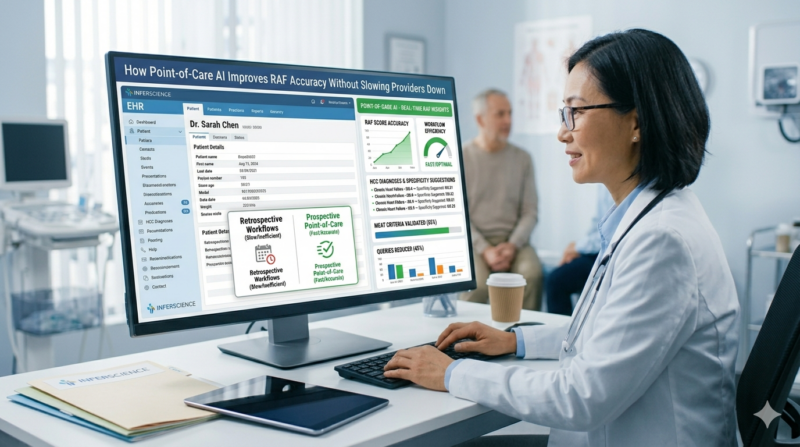
RAF accuracy has become increasingly difficult to maintain as CMS requirements evolve and documentation standards tighten. At the same time, providers are already operating under significant time pressure, with documentation burden consistently cited as a leading contributor to burnout.
Many organizations are still trying to solve this problem with retrospective workflows—chart reviews, coding queries, and post-visit corrections. These approaches introduce delays, increase administrative effort, and often fail to capture the full clinical picture.
The challenge is clear: improve RAF accuracy without adding more work for clinicians.
Point-of-care AI addresses this challenge by reinforcing documentation in real time, ensuring accuracy at the moment care is delivered rather than attempting to reconstruct it later.
Point-of-care AI in risk adjustment refers to technology that analyzes clinical data and supports documentation during the patient encounter. It helps providers capture accurate, complete diagnoses in real time, ensuring that RAF scores reflect true patient complexity.
Unlike retrospective tools, point-of-care AI operates within existing clinical workflows. It surfaces relevant insights—such as potential conditions, missing specificity, or incomplete documentation—while the provider is still with the patient.
This approach aligns with the broader industry shift toward encounter-level accuracy, where documentation must reflect what was actually assessed, monitored, and treated during the visit.
RAF accuracy measures how well a patient’s risk score reflects their true clinical complexity. It depends on complete, specific, and MEAT-supported documentation captured during the encounter.
When RAF accuracy is high, risk scores are both clinically valid and financially reliable. When it is low, organizations face missed revenue, audit exposure, and inconsistent performance.
RAF accuracy is difficult to achieve with traditional workflows because documentation gaps occur during the encounter but are identified too late through retrospective review. By the time issues are discovered, clinical context has already been lost.
Most legacy workflows follow a familiar pattern:
This process introduces several problems. Providers may not recall the details of the encounter, documentation updates may lack specificity, and important diagnoses may never be recovered at all.
These limitations are why many organizations are shifting toward prospective approaches that reinforce documentation earlier in the workflow.
👉 Related: From Retrospective to Prospective: Modernizing Risk Adjustment Workflows
Point-of-care AI improves RAF accuracy by identifying documentation gaps, surfacing relevant conditions, and validating MEAT elements during the encounter. This ensures diagnoses are complete and supported before the chart is closed.
Rather than relying on retrospective recovery, point-of-care AI focuses on first-pass accuracy.
It does this by:
This approach reduces missed diagnoses and improves the consistency of risk capture across providers.
It also aligns closely with strategies for closing documentation gaps at the source.
👉 Related: Closing HCC Coding Gaps at the Point of Care
Point-of-care AI does not slow providers down because it integrates directly into existing workflows and reduces the need for follow-up work. Instead of adding steps, it eliminates inefficiencies caused by retrospective queries and chart reviews.
In fact, it often reduces overall workload by:
This is particularly important in an environment where providers are already experiencing data fatigue and workflow fragmentation.
👉 Related: Combatting Data Fatigue: Turning FHIR Streams into Actionable Huddles
Point-of-care AI strengthens defensibility by ensuring that documentation is accurate, complete, and supported at the time of care. This reduces audit risk and improves consistency across encounters.
Under models like V28, defensibility has become the standard. Every diagnosis must be supported by clear clinical evidence and aligned with MEAT criteria.
Point-of-care AI supports this by:
👉 Related: Building a Defensible Risk Adjustment Program in a Post-V28 Environment
Inferscience enables point-of-care RAF accuracy by embedding real-time clinical intelligence directly into provider workflows. Its solutions help ensure documentation is complete, accurate, and aligned with risk adjustment requirements.
Together, these tools reduce reliance on retrospective workflows and support consistent, defensible documentation practices.
Point-of-care AI improves RAF accuracy while reducing administrative burden, creating a more efficient and sustainable workflow.
Organizations that adopt this approach typically see:
These improvements also support broader performance goals, including financial stability and compliance readiness.
👉 Related: Proving ROI in Risk Adjustment: How to Measure Results Beyond Chart Review
No. Point-of-care AI improves documentation quality so coders can focus on validation, compliance, and complex case review rather than retrospective recovery.
No. Ambient tools capture conversations, while point-of-care AI validates, structures, and ensures documentation meets risk adjustment requirements.
Yes. Most modern solutions integrate using FHIR and API frameworks, allowing them to fit within existing clinical workflows.
No. It reduces workload by eliminating retrospective queries, minimizing rework, and delivering only relevant insights during the encounter.
RAF accuracy depends on what happens during the encounter, not after it.
Retrospective workflows alone can no longer meet the demands of modern risk adjustment, especially under evolving CMS models like V28. Documentation must be complete, specific, and defensible at the point of care.
Point-of-care AI enables this shift by reinforcing documentation in real time, improving accuracy without increasing burden.
Organizations that adopt this approach will see stronger RAF performance, reduced administrative effort, and improved compliance. Those that do not will continue to struggle with variability, missed diagnoses, and operational inefficiencies.
Contact Inferscience to learn how point-of-care AI can improve RAF accuracy.
Request a walkthrough to see how real-time documentation supports better outcomes.
