Risk adjustment in 2027 is not just another annual update.
The policy changes taking shape for 2027 are doing more than shifting payment mechanics. They’re changing how organizations need to think about documentation, coding workflows, and audit readiness. To help teams prepare, Inferscience is hosting a free webinar in partnership with VBC Exhibit Hall focused on the biggest risk adjustment shifts ahead and the actions that matter most right now.
Webinar details:
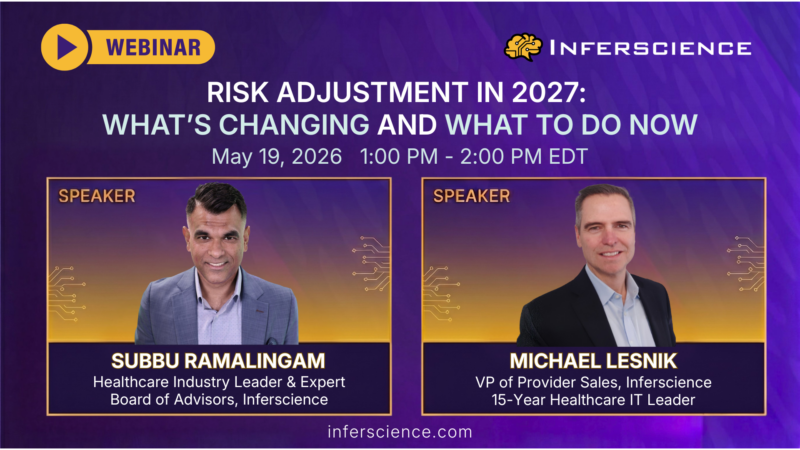
🎙️ Risk Adjustment in 2027: What’s Changing and What to Do Now
📆 Tue, May 19, 2026 1:00 PM – 2:00 PM EDT
Led by Subbu Ramalingam and Michael Lesnik, the session also draws on Inferscience’s experience supporting risk and quality programs across 2 million-plus patient lives over 10-plus years, with a specific focus on documentation integrity, RAF accuracy, and audit readiness.
Here are three of the biggest takeaways attendees will walk away with.
At first glance, the 2027 Medicare Advantage rate environment looks favorable. The webinar highlights a +2.48% net rate increase, $13B+ in dollar impact, a 5.33% effective growth rate, and a 5.9% coding pattern adjustment held at the statutory minimum.
But there is an important catch. The favorable rate reflects a model decision, not a softer stance from CMS on risk adjustment oversight. CMS retained the 2024 model rather than advancing V28 further. This creates a window, not a permanent reprieve.
That matters because the underlying direction has not changed. Documentation that occurs away from the clinical encounter counts for less, or not at all. The opportunity in front of organizations right now is to use this period to strengthen encounter-based documentation practices before the next round of pressure arrives.
A favorable rate should not create complacency. It should create urgency.
One of the most important sections of the webinar focuses on the exclusion of unlinked chart review records. Beginning in CY 2027, diagnoses from chart review records that are not tied to a specific encounter will no longer count for risk adjustment, with a limited exception for certain MA-to-MA switches.
This is a major operational shift. If your HCC capture still depends heavily on retrospective chart reviews that are not linked to encounters, that revenue is at risk.
The webinar pairs that policy change with another important trend: expanded CMS encounter data visibility and a more aggressive RADV environment. The message is straightforward. CMS is narrowing what counts while simultaneously increasing what it can see.
That is what makes retrospective-only strategies increasingly hard to defend.
The session breaks this down through three encounter-based workflows that matter more going forward:
The broader message is that retrospective review is not disappearing, but it is being de-emphasized. The future is much more clearly encounter-linked.
One of the strongest ideas in the webinar is that high performance does not come from one tactic. It comes from using all three encounter-based strategies together.
Organizations that rely on only one approach consistently underperform on risk score accuracy. The highest-performing programs run pre-visit, point of care, and post-visit review as a coordinated pipeline. The output is not just more codes captured. It is defensible documentation that can stand up in a RADV audit.
The webinar defines that defensible practice in practical terms:
The discussion also broadens beyond risk adjustment alone. The presentation notes that 11 Stars measures are being removed, that clinical and experience measures now carry more weight, and that Depression Screening and Follow-Up becomes the first behavioral health measure in Stars history, entering Stars in 2029 using 2027 measurement-year data.
The message is that Stars and risk adjustment are converging operationally. Better prospective workflows at the point of care now support both.
Finally, the webinar closes with a practical roadmap. Immediate actions include auditing unlinked chart review exposure, modeling revenue impact for CY 2027, and lining up RADV support resources. Q3 actions focus on encounter-based HCC documentation training, documentation validation, and second-level coding review processes. Later steps extend into care coordination workflows, new member planning, and building long-term encounter-based infrastructure that does not depend on retrospective unlinked review.
The strongest reason to attend is that this is not framed as a generic market update. It is a specific look at what is different, what is becoming harder to defend, and what to do about it now.
If your organization is still asking questions like:
then this session is built for you.
The bottom line is simple. 2027 changes the math on how risk is captured. This webinar is meant to help organizations respond before those pressures show up in revenue and audit performance.
Join Subbu Ramalingam and Michael Lesnik for Risk Adjustment in 2027: What’s Changing and What to Do Now and walk away with a clearer view of what is changing, why retrospective strategies are losing ground, and what it takes to build a more encounter-based, defensible risk adjustment workflow.
