A 700-provider clinically integrated network — three entities, 80,000+ patients — has coded HCCs with Inferscience inside athenaOne since 2020, with 98% coding accuracy and earned shared savings under MSSP.
→ Read the case study
Our NLP-driven HCC Assistant streamlines risk review so clinicians can code confidently — in less than 10 minutes. HCC Assistant helps you:
From one athenaOne organization over 8 months. Read the case study →
HCC Assistant saves providers hours of repetitive work and helps the average practice improve RAF accuracy by 35%.
Our software leverages advanced Natural Language Processing (NLP) to analyze structured and unstructured data in the patient’s medical chart. It then uses complex rules to find diagnoses that may have been overlooked before displaying the HCC code suggestions in real time via the EHR.
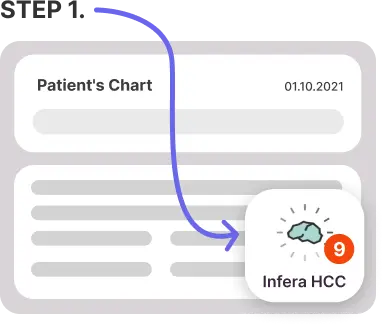
Open your patient’s chart and let the HCC risk adjustment app automatically analyze the clinical information directly from your EHR or notes.
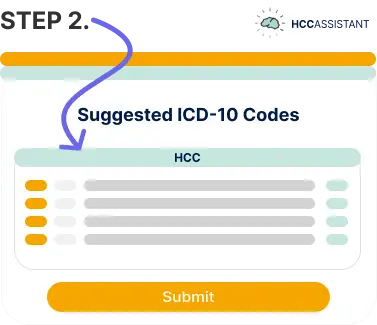
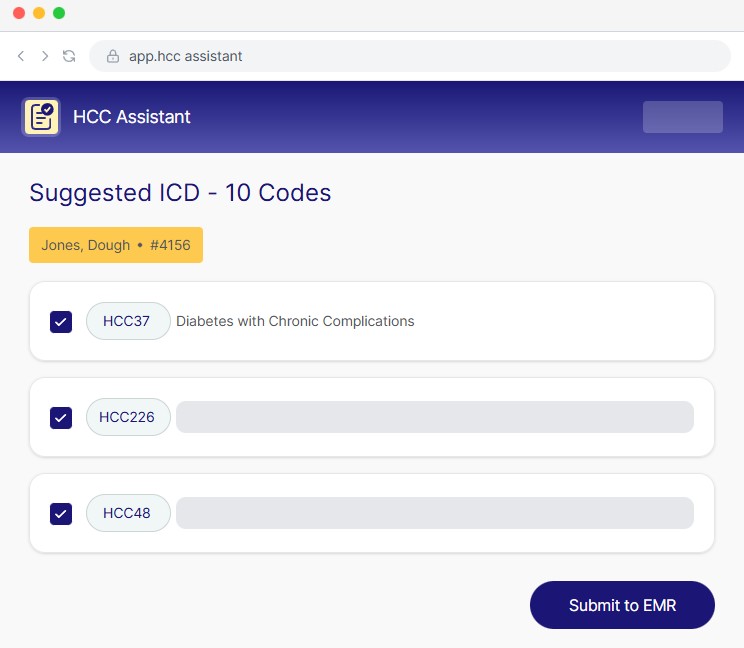
Review the suggested HCC codes and select the ones you want to document. You can also write your Plan of Care in the HCC Assistant.
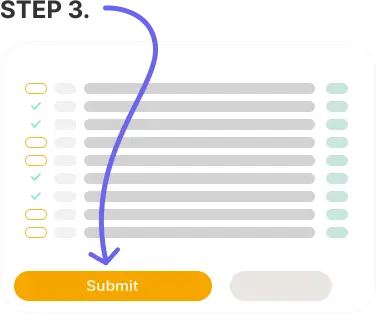
Click “Submit” to add selected HCC codes to the Assessment and Plan!

HCC coding is a tremendous time commitment for providers and takes their attention away from patients.
The HCC Assistant undertakes all the complex, time-consuming analysis over – empowering providers to simply review the recommendations and submit accurate HCC codes.
Inaccurate HCC coding means your RAF scores may be lower than they should, leading you to miss out on Medicare Advantage funding.
The HCC Assistant reviews the patient chart’s data to suggest diagnoses that may have otherwise been missed, with 98% accuracy. This has led to Medicare funding increasing by 11% for HCC Assistant users.
With data stored in multiple systems, the process of manually combining sources to gain an accurate picture of patient health is difficult and time-consuming.
The HCC Assistant uses NLP to analyze information from all sources and fill gaps in your patient data – allowing you to capture all possible HCC codes for your patients.
“In 8 months, our organization has presented more than 269K HCC codes to Providers and Advance Providers. Our coders and 300+ primary care providers find it to be very straightforward and user friendly.”
athenaOne User
Billing Staff, Multispecialty
athenaOne User
Administrative Staff, Multispecialty
“It has been a great opportunity to work with the Inferscience program, it is very user friendly. It enhances our accuracy and consistency with the HCC coding and allows us to produce quality service for our providers.”
athenaOne User
Administrative/Clerical Staff, Multispecialty

Instant Access to Patient Data:
The HCC Assistant centralizes and analyses all patient data, from unstructured to structured data.

Automatic care plans:
The HCC Assistant suggests a comprehensive plan of care based on each patient’s medical history.

Seamless compliance:
Built to CMS-HCC compliance standards and updated with every model release, including CMS-HCC V28
Accurate documentation of patient conditions is critical to predict the risk and future cost of your Medicare Advantage patients.
The following example shows how the RAF score for a 78-year-old male can be significantly raised through accurate documentation and HCC coding – resulting in thousands of dollars in additional funding.
| Risk adjustment factor (RAF) | RAF score | Expected annual expenditure and funding |
|---|---|---|
| Male 75 to 79 years old 1.062 $9,611 | 1.062 | $9,611 |
| HCC 86, Acute myocardial infarction 0.282 $2,552 | 0.282 | $2,552 |
| HCC 111, Chronic obstructive pulmonary disease 0.355 $3,213 | 0.355 | $3,213 |
| HCC 137, Renal failure stage IV | 0.230 | $2,082 |
Total: |
1.929 | $17,457 |
Our healthcare API empowers payers and third-party vendors to harness advanced HCC coding analysis, facilitating healthcare interoperability and delivering deeper insights to address the evolving needs of patients, providers, and payers.
Payers or third-party vendors connect the API to their existing system.
Claims files are uploaded (PDF or CCDA documents), after which the data is extracted and analyzed using intelligent rules.
The API delivers analysis in JSON format that can be retrieved in seconds.
HCC coding software analyzes a patient’s chart to identify and validate the Hierarchical Condition Category (HCC) diagnoses that drive Medicare Advantage risk adjustment. HCC Assistant does this in real time inside the EHR, surfacing missed and suspected conditions during the visit so providers can document them accurately at the point of care — instead of chasing them in a retrospective review weeks later.
HCC Assistant is a real-time HCC coding tool that runs inside your EHR. It uses natural language processing (NLP) to read both structured and unstructured data in the patient’s chart, applies clinical rules to find diagnoses that may have been overlooked, and displays suggested HCC codes directly in the workflow. The provider reviews each suggestion, selects the ones that apply, and submits them to the assessment and plan — the physician makes the final call on every code.
HCC Assistant supports audit-ready documentation by attaching a clear evidence trail to every suggested code, so each diagnosis is backed by the clinical support (MEAT) that RADV review requires. Because coding happens prospectively at the point of care, the supporting documentation is captured in the encounter itself rather than reconstructed after the fact.
HCC Assistant is built for provider organizations in value-based and Medicare Advantage arrangements — primary care groups, multispecialty practices, and ACOs — that want to improve RAF accuracy and HCC recapture without adding retrospective chart-review labor. It’s used by organizations ranging from single practices to 700-provider clinically integrated networks.
Retrospective coding reviews charts after the encounter; prospective, point-of-care coding surfaces diagnoses during the visit, while documentation can still be corrected at the source. HCC Assistant is prospective — it works inside the note during the encounter, which produces more complete and more defensible, MEAT-supported documentation. That difference matters more than ever as CMS moves away from unlinked chart review as a submission path.
HCC Assistant delivers 98% coding accuracy. Its suggestions are evidence-based — every code comes with a digital trail showing why it was surfaced — and physicians can reject any suggestion that doesn’t apply, which keeps the final coding both accurate and defensible. Read the case study here.
No — it’s built to reduce provider workload, not add to it. HCC Assistant does the time-consuming chart analysis automatically and presents ready-to-review suggestions inside the workflow, so providers spend less time digging through records and more time with patients. At one large clinically integrated network, 700 providers across three entities adopted it inside athenaOne with minimal workflow disruption. Read the case study here.
Book a demo and our team will show HCC Assistant running inside your EHR with your workflow.