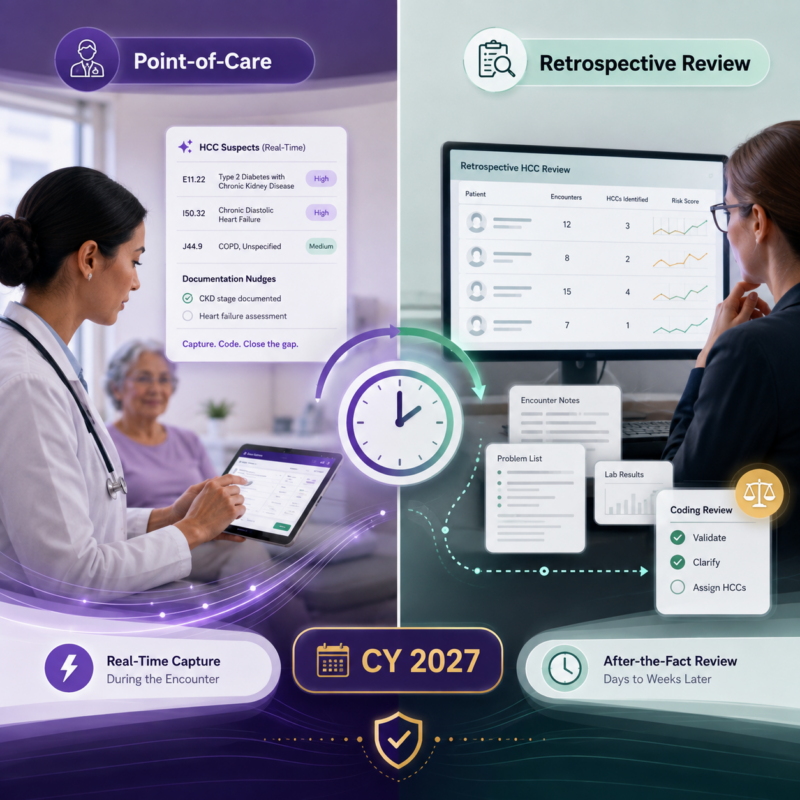
Point-of-care HCC coding supports diagnosis evaluation and documentation as part of the clinical encounter, while retrospective HCC review examines records after the encounter to identify coding and documentation gaps. That timing affects documentation quality, provider burden, RAF accuracy, and, under CMS policy for CY 2027, how certain risk-adjustment diagnoses are associated with encounter data.
Point-of-care HCC coding and retrospective review are often described as two strategies for accomplishing the same goal: capturing diagnoses that contribute to a patient’s risk adjustment factor (RAF) score.
But they play different roles.
Point-of-care workflows bring relevant clinical information and suspected conditions to the provider before or during the visit. Retrospective workflows review the record after the encounter has closed.
That difference affects how much clinical context is available, when documentation gaps can be addressed, how much follow-up work is created, and how diagnosis information moves through the risk-adjustment process.
It becomes particularly important in CY 2027.
CMS has finalized a policy excluding diagnoses submitted through unlinked chart review records (CRRs) from Medicare Advantage risk-score calculations, with a limited exception for certain beneficiaries who switch MA organizations. The policy does not eliminate retrospective review. It does, however, make complete encounter data and encounter-associated diagnosis capture more important. CMS outlines the change in its CY 2027 Medicare Advantage and Part D Rate Announcement.
For organizations still relying heavily on retrospective diagnosis recovery, the balance between the two workflows is changing.
The primary difference is timing. Point-of-care HCC coding supports diagnosis evaluation and documentation before or during the patient encounter. Retrospective review analyzes completed records afterward to identify coding gaps, documentation issues, and validation opportunities.
Point-of-care coding, often discussed as part of a prospective risk-adjustment strategy, brings relevant clinical information and suspected conditions into the provider’s workflow while the patient and current clinical context are available.
The provider can review the patient’s history, determine whether a condition is currently supported, and document that clinical assessment as part of the visit.
Retrospective review happens later.
Coders, auditors, or risk-adjustment teams review completed medical records to identify diagnoses that may have been documented but not coded, evaluate whether submitted diagnoses have adequate support, find documentation gaps, and perform additions or deletions when appropriate.
| Factor | Point-of-Care HCC Coding | Retrospective HCC Review |
|---|---|---|
| Timing | Before or during the encounter | After the encounter |
| Primary user | Provider and clinical team | Coders, reviewers, auditors |
| Clinical context | Available in real time | Limited to completed documentation |
| Documentation gaps | Can be addressed during care | May require follow-up |
| Provider queries | Can reduce downstream queries | May generate follow-up queries |
| Primary role | Capture and documentation | Validation and gap identification |
| CY 2027 consideration | Supports encounter-associated workflows | Must distinguish linked from unlinked CRRs |
Both approaches can contribute to an effective risk-adjustment program. They simply should not be treated as interchangeable.
That is also why many organizations are reconsidering the traditional model of relying on retrospective chart review as the primary capture mechanism and moving toward more prospective risk-adjustment workflows.
Capturing a diagnosis during the encounter allows the provider to document the condition while the clinical evidence and decision-making are current. Retrospective reviewers have to work with what was recorded in the completed medical record.
Risk-adjustment coding depends on documentation that supports the reported diagnosis.
At the point of care, the provider can evaluate a suspected chronic condition against the patient’s current clinical picture. Relevant assessment, monitoring, treatment, and other supporting information can be documented as part of the encounter.
If the condition is not supported, the provider can reject or resolve the suspect rather than allowing an unsupported diagnosis to move further downstream.
Retrospective reviewers do not have that same opportunity.
Once the encounter has closed, they generally have to rely on the documentation that already exists. If the original note does not adequately establish the condition or its relevance to the encounter, the reviewer cannot recreate clinical decision-making that was never documented.
A provider query may sometimes be appropriate, but that creates another workflow and another demand on the clinician.
Point-of-care HCC workflows address the problem earlier, when the provider still has both the patient and the clinical context available. That same principle is central to building RADV audit-defensible documentation: the goal is not simply to have a diagnosis code in the record, but to have documentation that shows why it belongs there.
Point-of-care HCC coding can support RAF accuracy by giving clinicians an opportunity to evaluate suspected conditions before those diagnoses move through the risk-adjustment workflow. Supported conditions can be documented appropriately, while unsupported conditions can be rejected rather than carried forward.
RAF accuracy is not simply about finding more HCCs.
An accurate risk score depends on capturing diagnoses that are clinically supported and eligible under applicable risk-adjustment requirements. That makes both missed diagnoses and unsupported diagnoses important.
At the point of care, a clinician can evaluate a suspected condition using the patient’s history, current findings, medications, labs, and other available information.
The provider makes the clinical determination. The technology should support that decision, not make it for them.
A useful point-of-care system therefore should not simply maximize the number of HCC suspects presented to clinicians. It needs to surface relevant evidence without creating so much noise that providers begin ignoring the information altogether.
That is part of the rationale behind using point-of-care AI to improve RAF accuracy. Moving suspecting closer to the clinical decision gives the provider an opportunity to determine what belongs in the record before coding and submission.
Retrospective review remains valuable for identifying gaps, but it cannot replace clinical judgment that was never documented.
The goal is not maximum capture. It is accurate, supported capture.
Retrospective HCC review can add administrative work when closed charts generate retrieval requests, coding reviews, or provider queries after the original encounter. Point-of-care workflows aim to address more documentation needs during the visit so less remediation is required later.
A retrospective workflow begins after much of the clinical work is already complete.
Records may need to be retrieved, reviewed, reconciled, and sometimes returned to providers for clarification. For clinicians, that can mean receiving a question about a patient encounter weeks or months after it happened.
The provider may have to reopen the chart, reconstruct the clinical context, review supporting evidence, and respond to the query while also managing current patients.
That contributes to provider abrasion and administrative workload.
Point-of-care workflows take a different approach. When relevant suspected conditions and documentation opportunities are presented during the encounter, the provider can address them while already reviewing the patient.
That does not eliminate every retrospective review or provider query. But better first-pass documentation can reduce the amount of work that has to be recovered downstream.
Inferscience has looked more closely at the connection between documentation burden and coding accuracy, particularly the role AI can play in helping providers address risk-adjustment needs without creating another disconnected workflow.
Beginning with CY 2027 risk-score calculations, CMS will exclude diagnoses submitted through unlinked chart review records from risk-score calculations, with a limited exception for certain beneficiaries who switch between Medicare Advantage organizations. The policy makes the distinction between encounter-associated diagnosis data and unlinked chart-review diagnoses especially important.
An unlinked chart review record is not associated with a specific previously submitted encounter data record.
CMS allows chart review records to add or delete diagnosis information. A CRR may be linked to an encounter data record or submitted as unlinked.
For CY 2027, CMS finalized the exclusion of diagnoses from unlinked CRRs from risk-score calculations, subject to the specified exception involving certain beneficiaries who move between MA organizations. CMS provides additional detail in the full CY 2027 Rate Announcement.
That policy should not be simplified to “retrospective diagnoses no longer count.”
Retrospective review can still play an important role. The critical question is whether diagnosis information satisfies CMS risk-adjustment requirements and, where applicable, is properly associated with encounter data.
CMS has also stated that MA organizations may continue submitting unlinked CRRs even though affected diagnoses generally will not be included in CY 2027 risk-score calculations.
The operational takeaway is more specific: organizations should prioritize complete, accurate encounter data and reduce their dependence on unlinked chart-review diagnoses as a way to add risk-adjustment information after the fact.
This is one of several risk adjustment shifts organizations need to prepare for in 2027.
Yes. Point-of-care workflows can help organizations address suspected conditions while the provider still has the patient, the clinical evidence, and the encounter context available.
That supports three priorities:
That does not mean point-of-care technology automatically produces compliant coding.
Clinical validation, complete documentation, accurate coding, data submission, and appropriate oversight are still necessary.
AI can provide information and surface potential gaps. Clinical judgment still belongs to the provider.
No. Retrospective HCC review remains valuable for validation, auditing, gap detection, and two-way review. CY 2027 changes the importance of unlinked chart review records; it does not eliminate retrospective review as a risk-adjustment function.
A mature risk-adjustment program can use prospective, point-of-care, concurrent, and retrospective processes together.
The difference is what each process is being asked to do.
Point-of-care workflows provide an early opportunity to evaluate suspected conditions and strengthen documentation.
Retrospective workflows can then act as a validation and quality-control layer by asking:
This is especially useful for two-way review, where organizations look for both diagnoses that were missed and diagnoses that should not remain in risk-adjustment data.
The shift is therefore not from retrospective review to no retrospective review.
It is a shift away from depending on retrospective recovery as the center of the program and toward earlier clinical capture followed by downstream validation.
A modern workflow can operate across four stages.
Providers should not have to manually search years of fragmented chart history before every visit.
AI-assisted chart preparation can synthesize relevant history and identify potential gaps for provider review.
Inferscience’s AI Chart Assistant is designed to support this pre-visit preparation by bringing important clinical information into a more usable view.
Potential conditions should be surfaced in a way that supports the provider’s workflow rather than interrupting it.
HCC Assistant brings risk-adjustment guidance into the clinical workflow so providers can review relevant conditions while treating the patient.
The clinician remains responsible for determining whether each diagnosis is supported.
Point-of-care capture does not remove the need for validation.
Diagnoses should still be checked against the supporting documentation and applicable coding and risk-adjustment requirements before they are submitted.
HCC Validator adds that validation layer to help identify unsupported diagnoses and strengthen compliance and RADV readiness.
Retrospective analysis can then identify what earlier stages missed: coding gaps, unsupported diagnoses, recurring documentation problems, or workflow issues.
Instead of serving as the primary mechanism for recovering risk after the encounter, retrospective review becomes part of an ongoing quality-control process.
The workflow looks more like this:
Prepare → Evaluate → Document → Validate → Review
Neither approach should operate alone. Point-of-care coding is better suited to real-time clinical evaluation and documentation, while retrospective review is valuable for validation, auditing, and identifying gaps after the encounter. For CY 2027, organizations should pay particular attention to CMS requirements affecting diagnoses submitted through unlinked CRRs.
The strongest risk-adjustment program is not purely prospective or purely retrospective.
It uses each workflow where it provides the most value.
Point-of-care tools address risk while clinical context is available. Pre-submission validation catches documentation and coding problems before they move downstream. Retrospective review identifies what earlier processes missed and provides information that can improve future performance.
That sequence becomes more important as CMS continues to emphasize the integrity of encounter and risk-adjustment data.
Point-of-care HCC coding is a workflow in which relevant diagnoses and suspected conditions are evaluated as part of the clinical encounter. It gives providers an opportunity to confirm, document, or reject conditions while both the patient and clinical information are current.
Retrospective HCC review occurs after the patient encounter. Coders, auditors, or risk-adjustment teams analyze completed records to identify coding gaps, validate diagnoses, and determine whether additions or deletions may be appropriate.
An unlinked chart review record, or CRR, is a chart review submission that is not linked to a previously submitted encounter data record. CMS has finalized a policy generally excluding diagnoses submitted through unlinked CRRs from CY 2027 risk-score calculations, subject to a specified exception.
No. The CY 2027 CMS policy specifically addresses diagnoses submitted through unlinked chart review records. It should not be interpreted as a blanket prohibition on retrospective review or every diagnosis identified retrospectively.
Yes. Retrospective review can support validation, auditing, two-way coding, documentation improvement, and gap detection. Its role increasingly complements earlier capture rather than serving as the sole or primary capture strategy.
Point-of-care workflows allow providers to address relevant conditions while they are already reviewing the patient. Better documentation during the original encounter can reduce the need for downstream remediation and follow-up queries.
AI can surface relevant clinical information and potential conditions, but clinical and coding decisions still require human judgment and supporting documentation. AI should assist the workflow rather than independently establish diagnoses.
Organizations should review their reliance on unlinked CRRs, strengthen encounter-data completeness, improve documentation and coding workflows, validate diagnoses before submission, and use retrospective analysis to identify remaining gaps and improve future encounters.
Point-of-care and retrospective HCC coding both belong in a modern risk-adjustment program, but they do different jobs.
Point-of-care workflows give providers an opportunity to evaluate suspected conditions and document their clinical decisions while the encounter is still happening. Retrospective review gives risk-adjustment teams another opportunity to validate the record, identify gaps, and learn where the earlier workflow broke down.
CY 2027 makes the distinction more important.
CMS’s finalized treatment of diagnoses from unlinked chart review records gives Medicare Advantage organizations another reason to reduce dependence on after-the-fact diagnosis recovery that is disconnected from encounter data.
The answer is not to abandon retrospective review. It is to use it differently.
A modern HCC strategy brings relevant information to clinicians earlier, supports accurate documentation during the encounter, validates diagnoses before submission, and uses retrospective review as a final quality-control and improvement layer.
For organizations building that model, HCC Assistant, HCC Validator, AI Chart Assistant, and Quality Assistant support different stages of the point-of-care risk-adjustment workflow.
