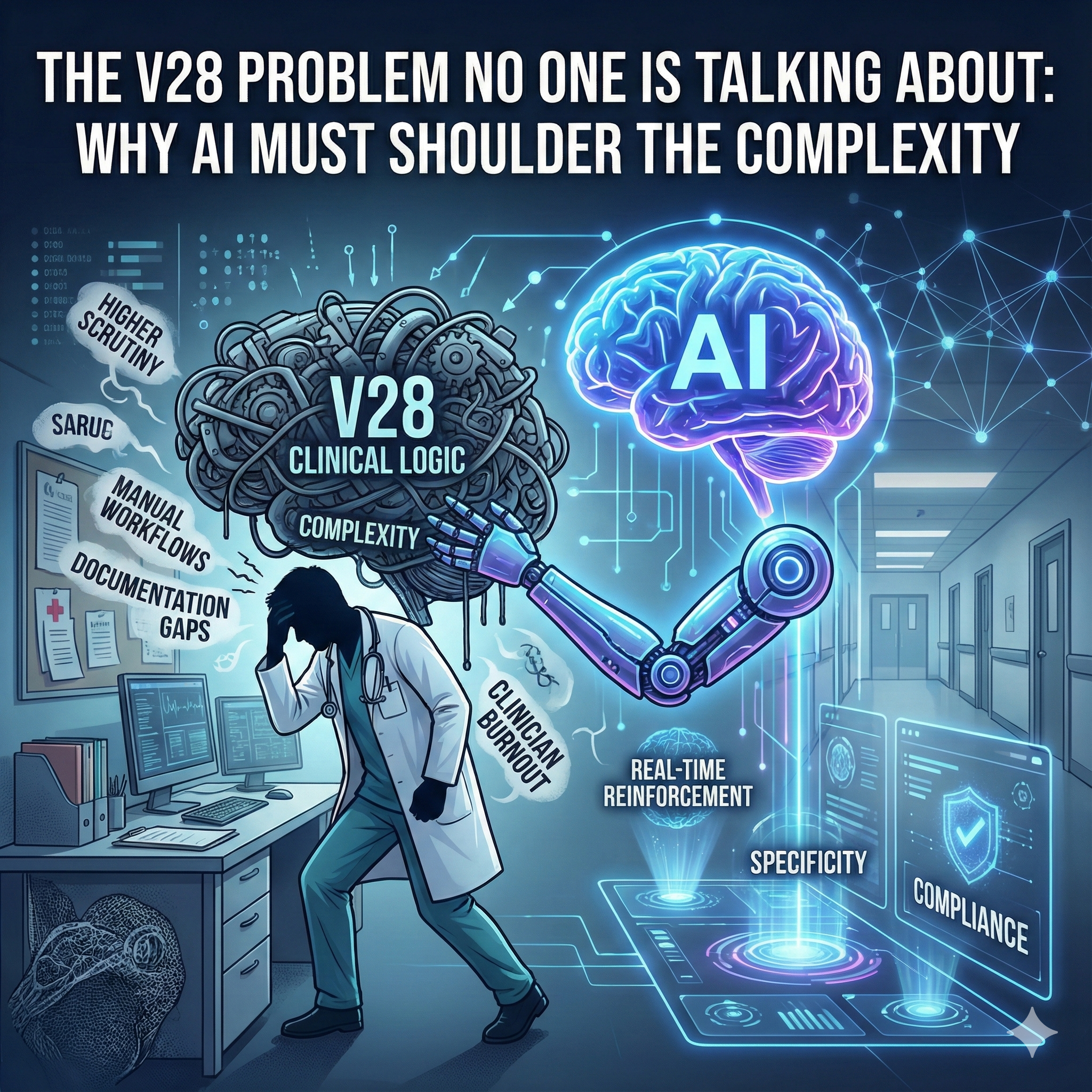

Now that V28 is fully in effect, clinicians, provider groups, and health systems are confronting a shift that goes far deeper than new condition categories. V28 restructured the logic behind how conditions relate, how severity is inferred, and what clinical evidence must appear in the record for documentation to be considered compliant. The rules are tighter, the expectations higher, and the operational pressure on frontline clinicians has increased.
Many organizations are still trying to absorb this change using the same manual workflows they relied on for V24 and V26. That approach will not hold. V28 introduces a level of complexity that human-only processes cannot reliably manage, especially in busy ambulatory settings where cognitive load is already high.
This is exactly why AI has to take on the burden.
The coding updates under V28 are the visible part of the change, but the real impact lies in the clinical logic that now governs compliant documentation. Conditions that were once captured routinely now require more precise clinical indicators. Diagnoses that previously carried forward year after year must be re-established with clear evidence. Comorbidities interact differently, and the documentation threshold to support them is higher.
Physicians are expected to understand these rule sets while still managing fast-paced clinic days, EHR navigation, medication changes, preventive care needs, and patient concerns. Even with the best intentions, no clinician can manually track dozens of evolving documentation criteria across every visit. Under V28, the complexity now sits inside the encounter, not in the coding office.
Payers have already adjusted to V28. Scrutiny has increased across both diagnoses and documentation patterns. Vague statements, outdated chronic conditions, and missing clinical details that once passed without issue are now being challenged. Plans are seeing more denial activity, and providers are receiving more coding queries and record requests.
This is not about catching mistakes. It reflects a shift in compliance expectations. Documentation that used to be acceptable is now insufficient. Clinicians need more specificity because the model demands it, not because they lack skill or diligence.
Most organizations still rely on a layered, manual model for documentation integrity:
This approach is already strained in high-volume primary care. Under V28 it becomes unmanageable.
The gaps form early in the encounter, not during coder review, and by the time issues are identified the clinician no longer has access to the full context of the visit. Multiply that across dozens of patients per day and the system becomes overloaded. There is simply no manual scaling solution for the level of real-time precision V28 requires.
AI is uniquely capable of handling the logic and specificity that V28 demands. Unlike human-led workflows, AI can:
The clinician still drives medical decision-making. AI serves as a real-time guardrail that ensures the record reflects the clinical truth with the precision required under V28. This is the kind of support that combines compliance needs with clinical realities rather than treating them as competing priorities.
The early indicators are consistent across markets: health systems that delay AI adoption under V28 experience higher error rates, more unsupported diagnoses, and greater audit exposure. Retrospective reviews identify gaps but cannot correct them with the same accuracy as real-time documentation. Payer scrutiny increases the administrative burden. Clinician frustration grows as they receive more queries that require revisiting old charts.
The risk is not theoretical. It is already materializing across organizations that are trying to manage V28 manually.
V28 ended the era where retrospective review could reliably compensate for documentation gaps. It shifted compliance into the exam room. The only way to meet that expectation is through real-time reinforcement. AI is the only tool capable of doing this consistently without adding steps or complexity for the clinician.
V28 raised the bar for specificity, logic, and documentation clarity. AI is what keeps organizations from falling under that bar.