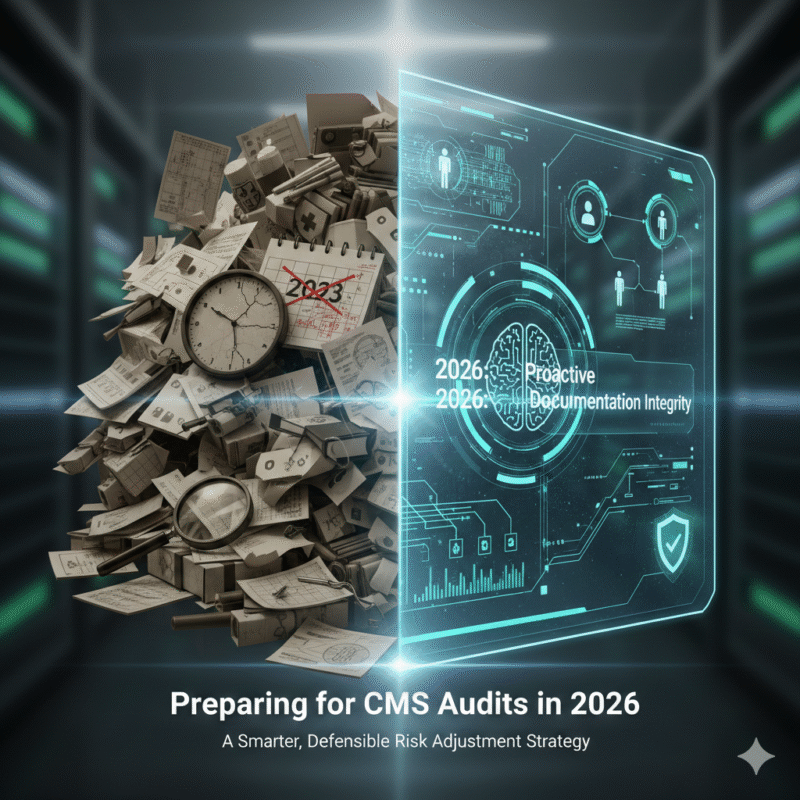
CMS audits are no longer periodic compliance events. They have become continuous operational risks that directly affect revenue stability, provider relationships, and organizational credibility.
As Medicare Advantage enrollment grows and regulatory scrutiny intensifies, CMS expectations around documentation accuracy and audit defensibility are rising. Plans and provider organizations are being asked to demonstrate something far more demanding than accurate coding alone: clear, encounter-level clinical evidence supporting every submitted diagnosis.
Many organizations still approach audit readiness as a retrospective exercise. Charts are reviewed after submission, documentation gaps are corrected through addenda, and compliance teams scramble to assemble defensible records when audits arrive.
That strategy is rapidly becoming unsustainable.
Preparing for CMS audits in 2026 requires a shift from reactive cleanup to proactive documentation integrity—ensuring records are audit-ready from the moment the encounter ends.
CMS audit methodology has evolved significantly over the past several years. Auditors are no longer evaluating documentation in isolation or relying on inferred clinical intent. Instead, audits increasingly focus on whether diagnoses are clearly supported by contemporaneous clinical evidence.
This shift reflects broader regulatory trends emphasizing transparency, interoperability, and data consistency across healthcare systems.
Under modern audit standards, organizations must demonstrate:
Clear linkage between diagnoses and clinical assessment
Evidence of monitoring, evaluation, treatment, or management (MEAT)
Documentation created during the encounter rather than reconstructed later
As healthcare data becomes more interconnected, inconsistencies are easier to detect. Documentation variability across providers, locations, and workflows now creates measurable compliance risk.
CMS auditors increasingly prioritize documentation that is:
Clinically specific and supported by evidence
Consistent across encounters and providers
Structured in a way that allows traceability from diagnosis to clinical rationale
Unsupported diagnoses, copied-forward conditions, or ambiguous notes are far more likely to trigger findings. The expectation is simple but demanding: every diagnosis must stand on its own clinical merit.
Historically, organizations prepared for audits through retrospective review processes. Coding teams examined charts months after visits. Compliance departments issued provider queries. Documentation corrections were added long after care occurred.
While this approach once mitigated risk, it struggles under modern scrutiny.
Retrospective workflows identify problems after submission rather than preventing them. By the time documentation gaps are discovered, clinicians may no longer recall the encounter clearly, making defensible clarification difficult.
Even when corrections are made, they may appear less credible than documentation created contemporaneously.
Several structural challenges limit retrospective audit preparation:
Clinical context fades quickly. Providers cannot easily reconstruct reasoning weeks or months later.
Copy-forward documentation introduces risk when conditions remain listed without updated MEAT support.
Manual review processes scale poorly as audit volume increases.
As CMS emphasizes encounter-level accuracy, organizations relying solely on retrospective remediation face growing exposure.
The issue is not effort. It is timing.
Audit readiness must begin earlier—inside the clinical workflow itself.
A defensible risk adjustment strategy starts with a simple principle: documentation quality must be ensured at the point of care.
Rather than correcting errors downstream, organizations must prevent unsupported diagnoses from entering the submission pipeline in the first place. This requires continuous documentation validation rather than periodic review cycles.
Prospective workflows focus on strengthening documentation during the encounter, when clinical reasoning is clearest and corrections are easiest.
Key elements of a modern audit-ready strategy include:
Real-time documentation validation
Standardized clinical evidence capture
Consistent provider workflows
Pre-submission diagnosis verification
When these elements are in place, audit preparation becomes far less disruptive because documentation is already defensible.
Artificial intelligence enables this shift by supporting clinicians and compliance teams simultaneously.
Real-time AI analyzes documentation as it is created, identifying gaps that may undermine audit defensibility. Instead of waiting for retrospective review, providers receive guidance while clinical context remains fresh.
AI can:
Validate MEAT elements during documentation
Identify unsupported or insufficiently specific diagnoses
Detect inconsistencies before charts are finalized
Structure clinical data automatically for audit traceability
The clinician remains fully in control of decision-making. AI functions as a guardrail, helping ensure that documentation accurately reflects clinical intent while meeting compliance expectations.
Inferscience supports this approach through integrated tools designed for prospective accuracy:
AI Chart Assistant reinforces documentation clarity during the encounter without disrupting workflow.
HCC Assistant surfaces risk adjustment opportunities and specificity requirements in real time, helping providers capture supported conditions accurately.
HCC Validator strengthens audit defensibility by verifying diagnosis support before submission, reducing downstream compliance risk.
Together, these solutions shift audit readiness upstream—where it has the greatest impact.
Organizations adopting prospective documentation strategies experience improvements that extend beyond compliance.
Audit response becomes faster because records already contain required evidence. Compliance teams spend less time assembling documentation and more time overseeing quality initiatives.
Financial predictability improves as unsupported diagnoses decline and RAF performance becomes more consistent. Reduced variability lowers exposure to extrapolated audit findings.
Provider experience also improves. Instead of receiving retrospective documentation queries, clinicians complete documentation correctly once, reducing administrative friction.
Key operational outcomes often include:
Reduced audit remediation effort
Stronger documentation consistency across providers
Faster audit response timelines
Improved collaboration between plans and providers
Most importantly, organizations move from audit reaction to audit prevention.
Q1: Does preparing for CMS audits require more manual review?
No. Modern audit strategies reduce manual effort by improving documentation accuracy at the source rather than expanding retrospective review.
Q2: Can AI improve audit defensibility without adding provider burden?
Yes. Real-time AI operates within existing workflows, supporting clinicians without introducing additional steps or complexity.
Q3: Do prospective workflows replace compliance teams?
No. Compliance teams remain essential but can focus on governance and oversight instead of documentation remediation.
CMS audits in 2026 will reward organizations that prioritize documentation integrity over retrospective correction.
As regulatory expectations evolve, defensible risk adjustment depends on encounter-level accuracy, consistent clinical evidence, and workflows that support providers rather than burden them. Reactive audit preparation alone can no longer keep pace with the scale and sophistication of modern review processes.
A smarter strategy shifts audit readiness upstream. By validating documentation in real time, standardizing evidence capture, and preventing unsupported diagnoses before submission, organizations can protect revenue while improving operational efficiency.
Inferscience helps plans and provider groups build this future-ready approach through AI-powered documentation tools that create audit-ready records by design—not by cleanup.
Contact Inferscience to learn how AI Chart Assistant, HCC Assistant, and HCC Validator can help your organization prepare for CMS audits with confidence in 2026 and beyond.
