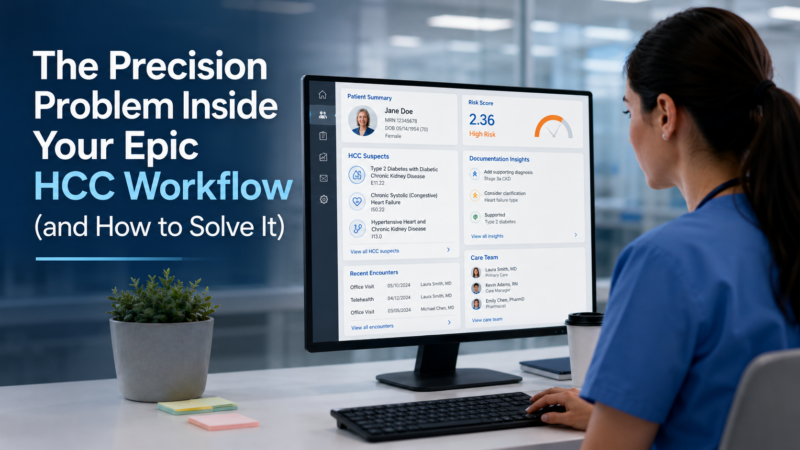
“We already have Epic for HCC coding.” It is one of the most common responses in conversations with organizations running Epic. And on the surface, it makes sense. Epic is the clinical and billing workflow foundation for many risk adjustment teams. The question is not whether Epic matters. The question is whether native Epic workflows can prioritize the highest-yield HCC review opportunities at the scale modern Medicare Advantage programs now require.
Epic supports HCC coding through point-of-care suspecting and charge router rules, but native workflows often stop at volume reduction. They can help identify broad categories of encounters that deserve attention, but they are not designed to perform the deeper prioritization needed to separate genuine capture opportunities from low-yield review work.
For Medicare Advantage plans and provider groups, that gap shows up quickly: large review queues, limited coder coverage, valid conditions that go uncaptured, and diagnoses that need stronger documentation support before they can withstand audit scrutiny. With CMS-HCC V28 fully in effect for payment year 2026 and RADV pressure continuing to intensify, the margin for blunt review workflows is getting smaller.
Epic offers two common native HCC touchpoints. The first is the OurPractice Advisory (OPA), formerly the Best Practice Advisory (BPA). The OPA surfaces coding suspects to providers during the patient encounter based on historical claims and basic clinical indicators like lab results. It can help with straightforward HCC recapture, but its suspect logic is limited. It generally does not identify new conditions, apply cross-source clinical logic, or flag the documentation specificity gaps that matter under V28.
The second is the charge router. When a provider closes a chart, an electronic charge enters the charge router, and rule-based edits direct certain charges to billing work queues for coder review. A typical rule might flag primary care visits for Medicare Advantage patients.
At a shop generating 10,000 charges per day, that rule might reduce the queue to 1,000. But coders still need a way to know which of those 1,000 charges are most likely to contain valid missed capture opportunities.
That is where the precision gap appears. The charge router can reduce the pile, but it does not always rank what matters inside the pile.
| Capability | Epic Native Workflow | Inferscience Precision Layer |
| Flags encounters for HCC review | Yes | Yes |
| Prioritizes highest-yield HCC opportunities | Limited | Yes |
| Filters low-yield charges before coder review | Limited | Yes |
| Works inside Epic billing work queues | Yes | Yes |
| Adds MEAT validation support | Workflow-dependent | Yes |
| Requires a separate coder platform | No | No |
Even after charge router rules narrow volume, the resulting queue can be too large for coding teams to work completely. Many organizations report that coders can reach only a portion of flagged charges. The remaining charts go unreviewed, and each unreviewed charge represents a possible missed capture: a condition that was present, documentable, and relevant to RAF accuracy, but never coded.
Hiring more coders is rarely the most practical answer. The root issue is precision, not effort. If the workflow sends coders too many low-yield charges, teams spend scarce review time on encounters that better analytics could have filtered out. Review coverage becomes a capacity problem, but the underlying cause is prioritization.
A useful diagnostic question is simple: of the charts Epic flags for HCC review, how many does your team actually reach? If the answer is anything less than 100%, the next question is what happens to the charts they cannot get to.
CMS-HCC V28 raises the stakes for Epic-based risk adjustment workflows. For payment year 2026, V28 expands HCC categories and increases the need for more specific documentation across many condition categories. That means more review complexity at the same time many coding teams are already operating at capacity.
RADV audits add another layer of pressure. CMS has active RADV audits across payment years 2018 through 2024 and has estimated approximately $17 billion in annual Medicare Advantage overpayments tied to unsupported diagnosis data. In this environment, HCC workflows need to support both accurate capture and defensible documentation. More flagged charges alone will not solve either problem.
Other HCC coding tools are designed to supplement Epic, and many apply more advanced analytics than native charge router rules. But many also operate outside of Epic. Coders have to log into a separate platform, learn a new interface, and toggle between systems to complete review work.
For teams already trying to keep up with volume, that context-switching matters. Even when an external tool identifies good opportunities, added workflow friction can limit adoption, slow review, and reduce the efficiency gains organizations expected.
Inferscience takes a different approach. Starting during the patient encounter and continuing through post-visit charge processing, it applies precision analytics at every stage and delivers results natively inside Epic. There is no external platform, no new interface, and no context-switching. Here is how it works:
The HCC Validator works after the encounter closes, reviewing the entire chart and flagging diagnoses that may lack sufficient documentation support. Unsupported codes are identified so they can be properly documented or removed before claim submission. With RADV audits active across payment years 2018 through 2024 and CMS estimating $17 billion in annual MA overpayments from unsupported data, that pre-submission validation is essential.
This is the difference between a machete and a surgeon’s scalpel. The charge router cuts volume. Inferscience cuts to the charges that actually matter.
Does Epic already do HCC coding?
Epic supports HCC coding through point-of-care suspecting with the OPA and post-visit charge router rules. These native tools can narrow review volume, but they generally do not provide the deeper analytics needed to prioritize the highest-yield missed capture opportunities.
What does Epic’s charge router do for HCC coding?
Epic’s charge router uses rules to direct certain charges into billing work queues for review. For example, an organization might flag primary care visits for Medicare Advantage patients. This can reduce total charge volume, but coders may still need to manually determine which charges actually contain valid HCC opportunities.
Can Epic’s charge router identify missed HCC capture opportunities?
The charge router can flag charges based on rules, but it is not built to perform advanced clinical prioritization on its own. Without a precision analytics layer, coders may still face large queues where high-yield and low-yield charges look similar.
Why do coding teams struggle with the volume Epic produces?
The issue is often not coder effort. It is prioritization. Broad charge router rules can produce more flagged charges than teams can review, which leaves some charts untouched and creates missed capture risk.
How can Medicare Advantage organizations reduce HCC coding review volume in Epic?
Organizations can reduce review volume by adding analytics that filter low-yield charges before they reach coders. The most effective approach keeps that prioritization inside Epic billing work queues so coders do not need to toggle into another platform.
Do coders need to learn a new system to use Inferscience?
No. Inferscience creates targeted tasks natively inside Epic billing work queues. Coders continue working in the same interface they already use.
How does CMS-HCC V28 affect HCC coding for Epic shops?
V28 is fully in effect for payment year 2026. It expands HCC categories from 86 to 115 and increases documentation specificity requirements, adding both complexity and review pressure for teams already working at capacity.
What is the difference between Epic HCC suspecting and HCC analytics?
Epic HCC suspecting helps surface possible conditions at the point of care, often based on historical claims or basic indicators. HCC analytics applies deeper logic across available data to prioritize which post-visit charges are most likely to contain valid missed capture opportunities and documentation gaps.
Epic is the workflow foundation for many risk adjustment teams. But as V28 increases specificity requirements and RADV audits put more pressure on documentation support, native workflows alone may not give coding teams the precision they need to keep up.
If you are unsure whether your organization has a precision problem, ask your coding manager how many of the charts flagged for HCC review your team actually reaches. If the answer is less than 100%, the next question is not just how to work harder. It is how to make sure the charts your team does review are the ones most likely to matter.
See how Inferscience can help your team prioritize HCC review inside Epic. Schedule a demo tailored to your charge volume, coder capacity, and current review coverage.
