
Artificial intelligence is no longer an abstract concept in healthcare. It’s already embedded in coding, documentation, chart review, and audit workflows across health plans and provider organizations. I see this firsthand in my work with teams trying to balance innovation with accuracy, efficiency with compliance.
As AI becomes operational, a critical question keeps coming up: how do we use AI to elevate healthcare decision-making without letting it override clinical judgment?
The answer lies in clinical oversight. AI should support clinicians, coders, and compliance teams — never replace them. Without clear guardrails, even well-intentioned AI strategies can introduce risk instead of reducing it.
AI excels at pattern recognition. It can scan thousands of records, identify correlations, flag potential diagnoses, and surface gaps far faster than any human could. That speed is incredibly powerful — but speed alone does not equal clinical insight.
Clinical meaning requires context. It requires understanding patient history, nuance, and intent. An algorithm may detect a pattern consistent with a condition, but only a clinician can determine whether that condition is truly present, relevant, and supported by evidence.
This is why AI should never be positioned as an autonomous decision-maker. Its role is to surface information, not to define truth.
As organizations expand their use of AI across risk adjustment and quality programs, oversight cannot be informal or ad hoc. It must be deliberate and repeatable.
Effective clinical oversight means that no AI recommendation enters the medical record without human review. It means there are defined points in the workflow where clinicians, coders, or compliance professionals evaluate AI-generated insights before action is taken.
Without these frameworks, organizations risk allowing unsupported diagnoses, incomplete documentation, or misapplied logic to flow directly into claims and quality reporting.
With oversight, AI becomes a powerful ally instead of a liability.
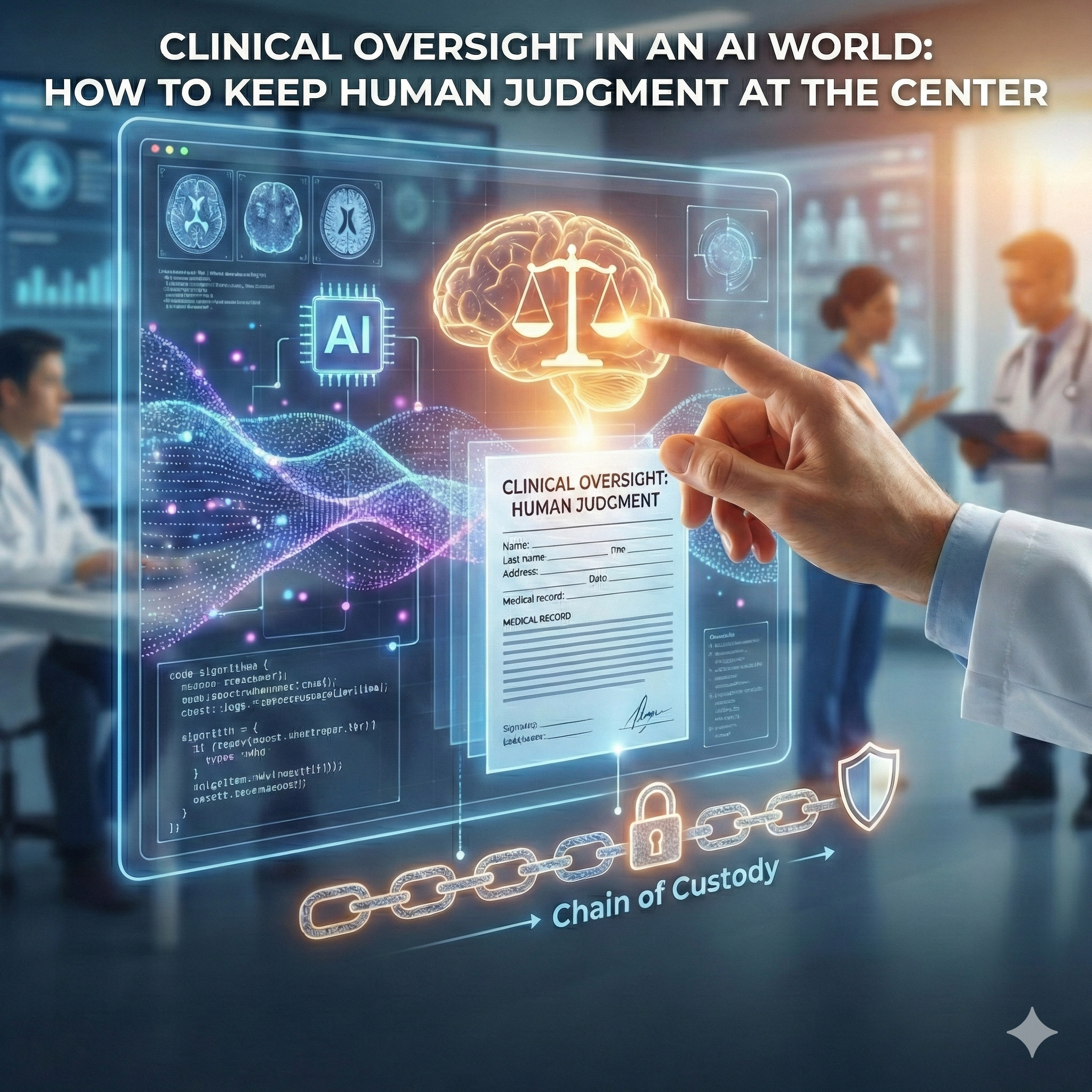
One concept I emphasize often is the “clinical chain of custody.” Every diagnosis, code, or quality measure should have a clear, traceable path from patient encounter to documentation to submission.
AI can help surface relevant data, but oversight ensures that evidence, reasoning, and final documentation stay connected. When those links are broken, audit risk increases dramatically.
In an era of heightened RADV and CMS scrutiny, this traceability is no longer optional. Strong oversight ensures that organizations can defend not just what was coded, but why it was coded.
Clinicians are far more likely to trust — and use — AI when they understand how it works. Black-box recommendations undermine confidence and lead to alert fatigue or outright rejection.
Transparent AI systems explain why a suggestion is being made. They show the supporting clinical indicators and allow clinicians to quickly assess relevance. This transparency reinforces oversight rather than competing with it.
When clinicians understand the “why,” they remain in control — and accuracy improves as a result.
Clinical oversight is not just about quality improvement; it is a defensive necessity. Unsupported documentation is one of the most common drivers of audit findings, denials, and financial exposure.
AI paired with strong oversight helps organizations catch issues before they become liabilities. It allows teams to identify missing evidence, incomplete documentation, or questionable diagnoses in real time, while corrections are still possible.
In today’s regulatory environment, that proactive approach is one of the most effective ways to protect revenue and reputation.
AI has an important role to play in the future of healthcare. But the most successful organizations will be those that design AI strategies around people — not around automation alone.
When clinicians remain the final arbiters of clinical truth, AI elevates decision-making instead of diluting it. Oversight ensures that technology serves medicine, not the other way around.
As I’ll discuss further at the Risk Adjustment Innovations Forum, the future of AI in coding, quality, and compliance depends not on how advanced our tools become, but on how thoughtfully we govern them.
Human judgment is not an obstacle to innovation. It is the foundation that makes innovation safe, scalable, and sustainable.