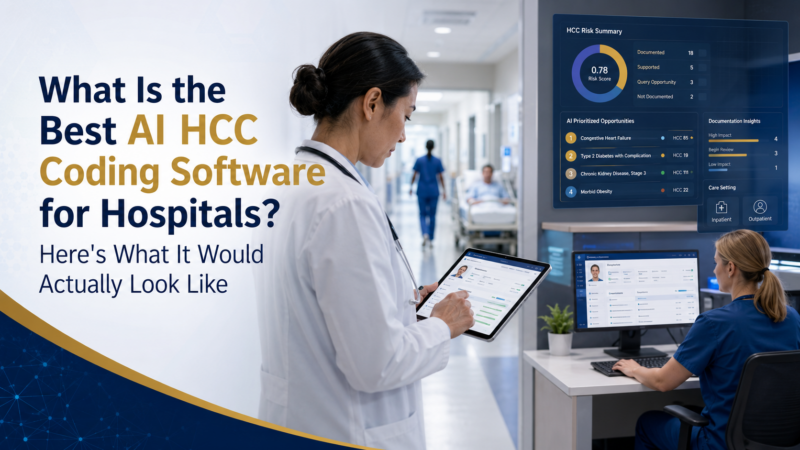
If you search for the best AI HCC coding software for hospitals, you’ll find ranked lists of vendors. What you won’t find is a clear answer to the question underneath the search: what should this software actually do for a hospital or health system, as opposed to a Medicare Advantage plan or a physician group?
That distinction matters more than most vendor comparisons acknowledge. Hospitals sit in a fundamentally different position in the risk adjustment ecosystem. They are not primarily plans collecting risk-adjusted premiums. They are providers operating across inpatient and outpatient settings, managing patients under a patchwork of risk contracts, and doing it with clinicians who are already spending more time in the EHR than with patients. The best HCC coding software for a hospital has to solve for that reality, not for the simpler case of a payer processing claims.
Rather than rank products, this article describes what the ideal would look like. If a hospital built the best possible AI HCC coding software from scratch, designed around how care actually gets delivered and documented in a health system, here is what it would do.
Health plans and hospitals both care about accurate HCC capture, but they experience the problem from opposite ends.
A health plan receives claims and diagnoses after care is delivered. Its risk adjustment work is largely about reviewing, validating, and submitting what providers documented. A hospital is where the documentation actually happens, in real time, during clinical encounters, by physicians who are focused on patient care rather than risk scores.
This creates hospital-specific challenges that plan-oriented software doesn’t address well. Hospitals operate across multiple care settings, inpatient, outpatient, emergency, and ambulatory, each with different documentation workflows. They manage patients under several risk models at once: traditional Medicare Advantage, ACO REACH, Medicare Shared Savings Program, and commercial value-based contracts, each with its own rules for which claims and conditions qualify. And they carry the burden of annual chronic condition recapture: conditions like diabetes with complications, COPD, and heart failure must be re-documented every calendar year or the risk score declines, affecting payments to both the plan and, in many contracts, the health system itself.
The financial stakes are substantial. One analysis of encounter data across 25 clients found more than $3 billion in missing reimbursement and shared savings opportunity tied to chronic conditions that were missing, incomplete, or inaccurately reflected in patient records. For a hospital in risk-based contracts, unaddressed HCC gaps are not just a coding problem. They are a direct hit to margin.
The best AI HCC coding software for hospitals is built around the encounter and the clinician, because that is where a health system’s risk adjustment problem lives.
The single most important capability is surfacing the right HCC suspects to the right person at the right moment, without drowning them in noise.
This is harder than it sounds, and it is where most tools fail. Clinicians frequently enter visits without a complete view of a patient’s chronic conditions, and when EHR workflows hide the history or relevance of those conditions, clinicians are left guessing which diagnoses need to be recaptured. The response from many vendors has been to add more alerts. That response backfires. Providers experiencing alert fatigue, workflow interruptions, and administrative burden from irrelevant alerts disengage from the tool entirely.
The problem is real and measurable. For every 30 minutes a provider spends seeing a patient, they spend roughly 36 minutes charting in the EHR. Any HCC tool that adds to that load, rather than reducing it, will be ignored no matter how accurate its suggestions are.
The best AI HCC coding software would do the opposite. It would surface a suspected condition only when the clinical evidence in the chart genuinely supports it, present the rationale and the supporting evidence alongside the suggestion, and let the clinician retain final authority over what gets documented. It would arrive as a small number of high-confidence, clinically relevant prompts, not a wall of flags. Adoption follows relevance. A tool that respects the clinician’s time and judgment gets used, and a tool that gets used captures conditions.
Inferscience’s HCC Assistant is built on this principle: AI-driven suspect identification delivered with the clinical evidence behind each suggestion, curated so that providers see relevant prompts rather than indiscriminate alerts.
For a hospital, EHR integration is not a feature. It is the foundation everything else sits on.
A health system runs on its EHR. Epic and Cerner are not tools that clinicians occasionally use; they are the environment in which all clinical work happens. HCC coding software that requires providers or coders to work in a separate application, upload charts manually, or toggle between systems introduces exactly the kind of workflow fragmentation that research links directly to clinician documentation burden.
The best AI HCC coding software for hospitals would live inside Epic and Cerner, not beside them. It would ingest clinical data automatically from the EHR rather than requiring manual chart uploads. It would surface suspects within the provider’s existing documentation workflow. And ideally it would support bidirectional integration, writing accepted coding opportunities back into the EHR so that the diagnosis is captured in the record at the source, not reconstructed later.
This depth of integration is what separates software that clinicians actually use from software that becomes shelfware. A health system evaluating options should treat native EHR integration as a threshold requirement, not a differentiator. If the tool does not fit inside the systems clinicians already use, nothing else about it matters.
Hospitals have something most health plans and small physician groups do not: dedicated clinical documentation integrity teams. The best AI HCC coding software would treat CDI as a partner in the workflow, not an afterthought.
CDI specialists exist to ensure that clinical documentation accurately reflects the patient’s condition and severity. That mission overlaps directly with HCC capture, but the two functions often run on separate tracks with separate tools. Leading platforms now treat clinical documentation integrity and coding as a unified workflow, with AI that identifies documentation gaps and vagueness that could lead to under-coding or audit risk while it assigns codes.
The best AI HCC coding software for hospitals would strengthen the CDI function rather than duplicate it. It would surface documentation gaps to CDI specialists with the specificity they need to write effective queries, flag conditions documented without sufficient MEAT support (Monitor, Evaluate, Assess, Treat), and give CDI teams a prioritized worklist based on clinical and financial impact rather than volume alone. When HCC capture and CDI work from the same intelligence, the query burden on physicians drops, documentation quality rises, and the diagnoses that result are defensible.
Inferscience’s AI Chart Assistant supports this by synthesizing the chart before the encounter, giving both providers and documentation teams a clear picture of the conditions that need attention going into the visit.
A hospital rarely operates under a single risk arrangement. It may have Medicare Advantage patients across several plans, an ACO REACH population, Medicare Shared Savings Program attribution, and commercial value-based contracts, all at the same time. Variation between these risk models makes it harder for providers to consistently capture conditions in ways that support both care quality and reimbursement.
The best AI HCC coding software would abstract that complexity away from the clinician. A physician should not need to know which contract a patient falls under to document their conditions correctly; the software should handle the model-specific logic behind the scenes. It would understand which diagnoses map to HCCs under the relevant model, recognize that only specific professional claims count toward HCC calculation in ACO contexts, and apply the correct rules automatically.
Annual recapture is the other piece. Chronic conditions do not carry forward on their own; they must be re-documented every calendar year to sustain the risk score. The best software would track which chronic conditions were documented in prior years, recognize when a patient is due for recapture, and surface those conditions at the next appropriate encounter, so that a patient’s diabetes with complications or heart failure is affirmatively re-documented rather than silently dropped. For a health system whose contract revenue depends on accurate risk scores, systematic recapture is one of the highest-value functions the software can perform.
Capture without defensibility is a liability. The best AI HCC coding software for hospitals would build compliance into the workflow rather than bolting it on at audit time.
The regulatory environment leaves no room for weak documentation. A recent OIG audit found that 86 percent of sampled high-risk HCC conditions were unsupported by documentation, triggering significant clawbacks, and RADV audits are producing error rates in the 25 to 50 percent range for organizations with weak documentation practices. For hospitals in downside risk, an unsupported diagnosis is not just a rejected code; it is a repayment obligation.
The best software would prevent this at the source. It would validate that each captured HCC is supported by MEAT documentation in the clinical note, confirm that the encounter meets face-to-face and provider-type requirements, and flag diagnoses that lack current-year clinical support before they are submitted rather than after an audit surfaces them. It would also support two-way review, identifying not only conditions to add but conditions that appear in the record without adequate support, since add-only documentation practices carry compliance risk under current enforcement standards.
Inferscience’s HCC Validator performs exactly this function, validating diagnoses against documentation and compliance standards before they enter the submission pipeline, so that capture and defensibility move together.
Once the fundamentals are met, the best software distinguishes itself by how well it disappears into the work.
The best AI HCC coding software for hospitals would be nearly invisible to the clinician. It would deliver its intelligence through the tools providers already use, ask for their judgment only when it adds value, and quietly handle the model-specific and compliance-specific complexity in the background. It would give CDI teams and coders a sharper, prioritized view of where documentation can improve, and it would give administrators a clear line of sight into capture performance across every risk contract the system holds.
It would also make its reasoning legible. An AI suggestion that a clinician cannot understand or verify is one a clinician will dismiss. The best software shows its work: why a condition was suspected, what evidence supports it, and what documentation would confirm it. That transparency is what turns an algorithm into a trusted part of the clinical workflow.
The measure of the best AI HCC coding software for hospitals is not how many features it lists. It is whether accurate, defensible HCC capture becomes a natural byproduct of good clinical documentation, rather than a separate burden layered on top of it.
What is the best AI HCC coding software for hospitals? The best AI HCC coding software for hospitals captures diagnoses at the point of care across inpatient and outpatient settings, integrates natively with Epic and Cerner, surfaces only clinically relevant HCC suspects to avoid alert fatigue, supports annual recapture of chronic conditions, and works alongside clinical documentation integrity teams. Rather than adding a separate workflow, it makes accurate and defensible HCC capture a byproduct of good clinical documentation.
How is HCC coding software for hospitals different from software for health plans? Health plans receive and validate diagnoses after care is delivered, while hospitals are where documentation happens in real time. Hospital software must work across multiple care settings, handle several risk contracts at once (Medicare Advantage, ACO REACH, MSSP, and commercial value-based arrangements), support annual chronic condition recapture, and minimize the documentation burden on clinicians who are already spending more time in the EHR than with patients.
Why is EHR integration so important for hospital HCC coding software? A hospital runs on its EHR, so HCC coding software that requires a separate application or manual chart uploads creates workflow fragmentation that adds to clinician burden and reduces adoption. The best software integrates natively with Epic and Cerner, ingests clinical data automatically, surfaces suspects within the existing documentation workflow, and can write accepted diagnoses back into the record at the source.
How does AI HCC coding software work with clinical documentation integrity (CDI) teams? The best software treats CDI as a partner rather than a parallel function. It surfaces documentation gaps with enough specificity for CDI specialists to write effective physician queries, flags conditions that lack sufficient MEAT support, and provides a prioritized worklist based on clinical and financial impact. When HCC capture and CDI operate from the same intelligence, physician query burden drops and documentation quality improves.
How does HCC coding software help hospitals stay audit-ready? The best software builds compliance into the point of capture. It validates that each HCC is supported by MEAT documentation, confirms the encounter meets face-to-face and provider-type requirements, and flags diagnoses lacking current-year support before submission rather than after an audit. Given that a recent OIG audit found 86 percent of sampled high-risk conditions unsupported by documentation, preventing weak documentation at the source is essential for hospitals in downside risk.
The best AI HCC coding software for hospitals is not the platform with the most features or the largest client list. It is the one designed around how a health system actually works: across settings, under many contracts, inside the EHR, and in partnership with the clinicians and CDI teams who carry the documentation load.
A hospital that evaluates software against that standard, rather than against a generic vendor comparison, will find a smaller field of genuine fits. The right tool captures more, defends what it captures, and does both without asking overburdened clinicians to do more work. That is the bar. Everything short of it is a compromise a health system in risk-based contracts cannot afford.
To see how HCC Assistant and HCC Validator bring point-of-care capture and pre-submission validation together inside the hospital workflow, contact Inferscience for a walkthrough.
