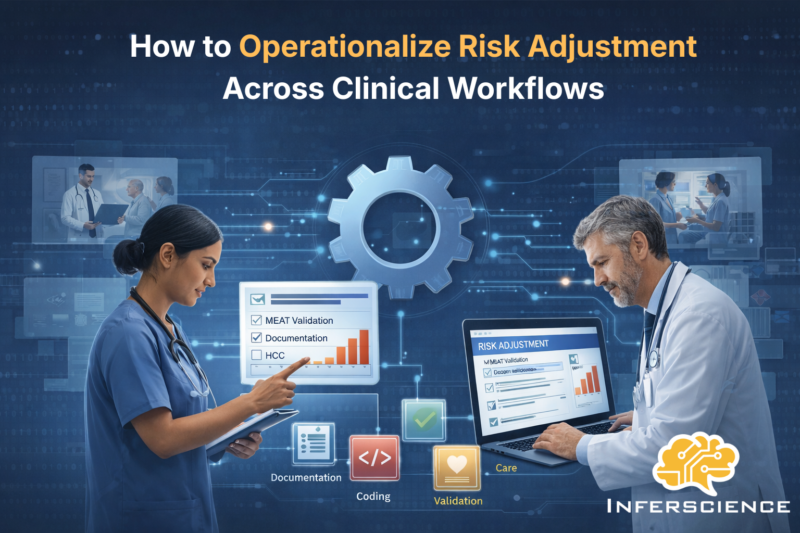
Risk adjustment has traditionally operated outside of clinical care.
Coding teams review documentation after the encounter. Quality teams run separate gap closure programs. Providers document under time pressure without clear alignment to risk adjustment requirements.
The result is fragmentation.
Documentation gaps form during the encounter, coding accuracy suffers downstream, and organizations rely heavily on retrospective workflows to recover missed opportunities.
That model no longer works.
To improve RAF accuracy, reduce administrative burden, and meet evolving CMS expectations, organizations must operationalize risk adjustment across clinical workflows—embedding it directly into how care is delivered.
Operationalizing risk adjustment means integrating documentation, coding, and validation processes directly into clinical workflows so that accurate risk capture occurs during the patient encounter. This eliminates reliance on retrospective correction and ensures documentation is complete, consistent, and audit-ready.
Instead of treating risk adjustment as a separate function, it becomes part of everyday clinical activity.
This shift enables:
Prospective risk adjustment focuses on capturing and validating diagnoses during the patient encounter, ensuring documentation is complete and accurate before submission.
It emphasizes first-pass accuracy rather than retrospective recovery.
Risk adjustment is difficult to operationalize because it depends on documentation accuracy, provider behavior, and coordination across multiple teams. Traditional workflows rely on retrospective review, which creates delays and disconnects between care delivery and coding.
Several challenges contribute to this:
These gaps make it difficult to create a consistent, scalable approach to risk adjustment.
👉 Related: From Retrospective to Prospective: Modernizing Risk Adjustment Workflows
Traditional workflows break down because documentation gaps form during the encounter but are identified too late through retrospective review. By the time issues are discovered, the provider is no longer in context, and the opportunity to capture accurate documentation has already passed.
This leads to:
Retrospective workflows attempt to fix documentation after the fact, but they cannot reliably recreate the full clinical picture.
👉 Related: Closing HCC Coding Gaps at the Point of Care
Organizations operationalize risk adjustment by embedding real-time documentation support, validation, and data integration into clinical workflows. This ensures accurate diagnosis capture during the encounter and reduces reliance on retrospective correction.
The focus shifts from recovery to prevention—ensuring documentation is complete the first time.
Step 1: Align documentation standards with MEAT requirements
Ensure providers understand what constitutes complete and compliant documentation.
Step 2: Embed documentation support at the point of care
Use tools that guide providers during the encounter without disrupting workflow.
Step 3: Integrate risk adjustment into clinical workflows
Eliminate the separation between documentation and coding processes.
Step 4: Enable real-time validation
Identify documentation gaps while the provider is still in context.
Step 5: Standardize workflows across providers
Reduce variability that leads to inconsistent coding outcomes.
Step 6: Measure performance beyond retrospective recovery
Focus on first-pass accuracy, documentation quality, and audit readiness.
👉 Related: Proving ROI in Risk Adjustment: How to Measure Results Beyond Chart Review
Point-of-care AI enables operationalization by delivering real-time insights, validating documentation, and integrating risk adjustment directly into provider workflows. It ensures that documentation is accurate and complete before the encounter ends.
This approach improves both efficiency and accuracy by:
It also helps organizations manage the growing volume of clinical data by turning it into actionable guidance.
👉 Related: Combatting Data Fatigue: Turning FHIR Streams into Actionable Huddles
Inferscience operationalizes risk adjustment by embedding real-time clinical intelligence into EHR workflows. Its solutions ensure that documentation is complete, accurate, and aligned with coding requirements at the point of care.
Together, these tools reduce reliance on retrospective workflows and enable a more consistent, scalable approach to risk adjustment.
Organizations that operationalize risk adjustment across clinical workflows see improvements in both performance and efficiency.
Common outcomes include:
These improvements create a more sustainable model for risk adjustment—one that aligns clinical care, documentation, and coding in real time.
👉 Related: Building a Defensible Risk Adjustment Program in a Post-V28 Environment
Operationalizing risk adjustment means integrating documentation, coding, and validation processes directly into clinical workflows to ensure accurate risk capture during the encounter.
Risk adjustment is difficult to implement because it requires coordination between providers, coders, and systems while relying on accurate, complete documentation.
Point-of-care AI helps operationalize risk adjustment by providing real-time documentation support, validating diagnoses, and reducing reliance on retrospective workflows.
Yes. By eliminating rework, reducing queries, and integrating documentation support into workflows, operationalization reduces administrative burden for providers.
Risk adjustment can no longer operate as a separate function.
To achieve consistent performance, organizations must align documentation, coding, and clinical workflows. Retrospective approaches alone are not sufficient to meet modern requirements for accuracy, compliance, and efficiency.
Operationalizing risk adjustment creates a more effective model—one where documentation is complete, coding is accurate, and workflows are streamlined in real time.
This shift is essential for organizations looking to improve RAF performance while reducing administrative burden.
Contact Inferscience to learn how to operationalize risk adjustment across clinical workflows.
Request a walkthrough to see how real-time documentation improves performance.
