Most Medicare Advantage plans have some form of HCC coding program in place. Fewer can answer a straightforward question: which parts of it are actually working?
It’s a question worth asking. Many organizations over-invest in retrospective chart review, the most expensive and labor-intensive approach, while neglecting the upstream strategies that prevent coding gaps from forming in the first place. The result is a risk adjustment program that runs hard but doesn’t run smart: coders chasing charts, providers re-queried on documentation they’ve already moved past, and leadership unable to pinpoint where revenue is leaking.
The pressure to get this right is intensifying. CMS-HCC V28 is now fully in effect for 2026, reducing mapped ICD-10 codes by nearly 7,000 while expanding HCC categories from 86 to 115. Specificity requirements are tighter. RADV audits covering payment years 2018 through 2024 are active, and CMS estimates approximately $17 billion in annual MA overpayments from unsupported diagnosis data. The margin for a single-strategy approach is gone.
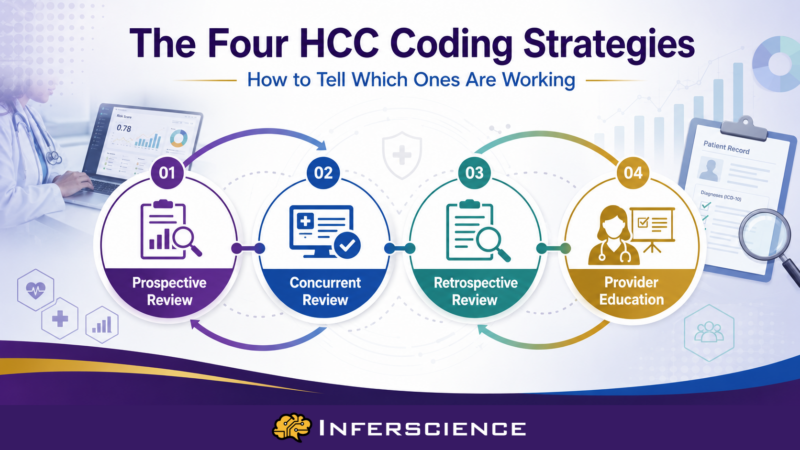
What follows is a framework for thinking about HCC coding not as one program but as four complementary strategies, each closing a different gap in the coding lifecycle, each independently measurable. When you know how each strategy is performing on its own, you stop guessing about where to invest and start making decisions based on data.
What is prospective HCC coding review? Prospective review is the pre-visit process where certified coders or AI-driven tools analyze a patient’s condition history, medications, lab results, and prior encounter data to identify HCC conditions that are likely present but have not yet been captured in the current calendar year. The goal is to give the provider a patient-specific suspect list before the appointment so that coding gaps are addressed at the point of care, not chased after the fact.
The logic is simple: a provider who walks into the room already aware of suspected conditions is far more likely to document and code them accurately than one working from memory alone. Prospective review shifts the highest-value coding opportunity upstream, where it’s cheapest and most effective to close.
This matters most for annual HCC recapture: the process of re-documenting chronic conditions each year to maintain their contribution to a patient’s RAF score. CMS requires annual revalidation of HCC diagnoses; a condition coded last year but not recaptured this year drops off the patient’s risk profile, reducing the plan’s reimbursement even though the condition still exists. Industry benchmarks target a recapture rate of at least 85%, but many plans achieve less than 60%. Prospective review directly targets the conditions most at risk of lapsing.
Under V28, prospective review carries additional weight. Conditions like diabetes without documented complications no longer map to an HCC, while diabetes with chronic complications carries meaningful value. Prospective tools must now surface higher-specificity suspects, not just historical codes, to maintain RAF accuracy. The HCC Assistant uses natural language processing to parse patient charts and surface clinically supported HCC suspects before and during encounters, helping organizations close recapture gaps before they become downstream problems.
What is concurrent HCC coding review? Concurrent review happens during or immediately after the patient encounter. Its purpose is to ensure that the provider’s documentation translates into accurate HCC codes on the initial claim, eliminating the most expensive gap in the coding lifecycle: conditions that were discussed and treated but never properly coded because documentation didn’t support the specificity required.
This is the highest-value strategy in the framework because it catches coding gaps before they become downstream problems. A condition captured accurately at the point of care doesn’t need a retrospective chart chase, a provider query, or a supplemental submission. Each of those downstream corrections costs time, money, and organizational attention that concurrent capture avoids entirely.
Under V28’s increased specificity requirements, concurrent review tools must do more than flag missing codes. They need to ensure that documented conditions meet MEAT criteria, Monitor, Evaluate, Assess/Address, Treat, in the clinical note itself. A diagnosis code captured without clinical support isn’t a revenue opportunity; it’s an audit liability. The most effective concurrent tools validate documentation quality in real time, not just code presence.
Integration matters here more than in any other strategy. Provider adoption collapses when tools require additional clicks, separate platforms, or workflow interruption. The AI Chart Assistant embeds real-time documentation intelligence directly into provider workflows, reinforcing clarity and structured capture without adding complexity. Meanwhile, the HCC Assistant surfaces clinically supported HCC codes as the provider charts, reducing documentation burden while improving coding accuracy at the same time.
What is retrospective HCC coding review? Retrospective review analyzes encounters after claims have been submitted to identify HCC codes that were missed during initial coding. It is the most commonly used strategy in Medicare Advantage risk adjustment and serves as the safety net for everything the upstream strategies didn’t catch.
It is also, when used as the primary coding strategy, the most expensive and labor-intensive approach in the framework.
The pattern is familiar to most MA plans: providers under-document, claims go out incomplete, and coders chase charts after the fact to identify missed HCCs. Supplemental claims or chart reviews are submitted to recapture the lost codes. This works, but it’s costly, slow, and increasingly risky. Every retrospective capture requires documentation that was created during the original encounter. If the documentation doesn’t support the specificity that V28 now demands, the code can’t be defensibly captured after the fact.
The capacity problem compounds the cost problem. Retrospective coding teams face the same volume challenge that plagues most HCC coding workflows: more charts flagged for review than coders can realistically reach. Without precision analytics, teams spend time on low-yield charts while high-value opportunities go unworked. Many organizations report that their retrospective teams can only review about 50% of flagged encounters.
None of this means retrospective review is unnecessary, it’s an essential safety net. But it should be shrinking over time, not growing. If your retrospective volume is flat or increasing year over year, it’s a signal that your upstream strategies aren’t closing the gaps they should be. The HCC Validator helps ensure that when retrospective captures do occur, they’re defensible, analyzing clinical notes against MEAT criteria and returning clear pass/fail validation so that every submitted code is audit-ready.
Why is provider education an HCC coding strategy? Because it’s the strategy that makes the other three work better.
Without education, prospective suspect lists go ignored. Concurrent tools get clicked past. Retrospective review volumes stay high because the same documentation gaps recur encounter after encounter. Education transforms providers from passive participants in the coding lifecycle into active partners in accurate risk capture.
Effective HCC education is not a one-time lunch-and-learn or an annual compliance webinar. It’s an ongoing, data-driven feedback loop, showing providers their personal coding patterns, missed opportunities, and documentation gaps relative to their peers and specialty benchmarks. The providers who improve fastest are the ones who receive specific, timely feedback tied to their own patient encounters, not generic training decks.
Under V28, the biggest educational priority is clinical specificity. Providers need to understand that an unspecified diabetes code no longer maps to an HCC, and that conditions like chronic kidney disease and heart failure require stage and severity documentation to capture value. This isn’t about teaching providers to code, it’s about helping them understand how their documentation choices translate into risk adjustment accuracy.
Education also functions as a compliance safeguard. CMS and OIG scrutinize whether diagnosis capture reflects genuine clinical conditions. Providers who document accurately from clinical intent, rather than from coding prompts, produce claims that withstand audit. The most defensible risk adjustment programs are the ones where providers understand why specificity matters, not just that it’s required.
The most efficient way to deliver this education is in the workflow itself. Inferscience’s provider solutions deliver real-time, in-context feedback as providers chart, turning every encounter into a learning opportunity. Providers learn by doing, not by attending. Over time, this continuous feedback loop reduces the volume of conditions that need retrospective correction, because providers are capturing them correctly the first time.
Having four strategies in place is not the same as having four strategies that work. The difference between a mature risk adjustment program and one that’s just running in place comes down to measurement, not at the program level, but at the strategy level.
Here’s a step-by-step approach to evaluating each strategy independently:
The most important meta-KPI across all of this is the ratio of upstream captures (prospective plus concurrent) to downstream captures (retrospective). In a maturing program, that ratio should trend upward over time. If it’s flat, your strategies are running but not improving. If it’s moving in the wrong direction, you’re accumulating technical debt in your risk adjustment program.
Solving the four-strategy challenge doesn’t require four separate tools. It requires a platform that connects the entire coding lifecycle inside the workflows providers and coders already use.
For prospective and concurrent capture, the HCC Assistant parses patient charts using natural language processing and surfaces clinically supported HCC suspects both before and during encounters. Providers see real-time guidance inside their EHR, not in a separate application, which means adoption isn’t a change management challenge. It’s a workflow enhancement.
For documentation quality at the point of care, the AI Chart Assistant reinforces clarity and structured capture during the encounter itself. This ensures that conditions meet specificity and MEAT requirements before the claim is generated, reducing the volume of documentation that needs retrospective correction.
For retrospective validation, the HCC Validator analyzes clinical notes and provides pass/fail validation against MEAT criteria, ensuring that every retrospective capture is defensible and audit-ready. In an environment where RADV audits are active and CMS scrutiny is increasing, validation isn’t optional, it’s the difference between captured revenue and audit liability.
For provider education, the platform delivers continuous, in-context feedback rather than periodic training sessions. Providers receive real-time signals about documentation quality and coding opportunities during their clinical work, building coding precision as a habit rather than a compliance exercise. Over time, this reduces chart chase volume and shifts the capture ratio upstream.
Organizations using Inferscience’s integrated approach report an average RAF accuracy improvement of 35%, driven not by more retrospective review, but by getting the coding right earlier in the lifecycle.
When all four strategies are in place and measured independently, organizations typically see:
Do we really need all four strategies, or can we focus on one or two?
Each strategy closes a different gap in the coding lifecycle. Prospective review prevents missed conditions. Concurrent review ensures accurate first-pass capture. Retrospective review catches what slipped through. Education reduces the recurrence of gaps over time. Plans that rely on only one or two strategies consistently underperform on both RAF accuracy and recapture rate, because they’re over-investing in downstream correction rather than upstream prevention.
How do we know if our retrospective review program is compensating for weak upstream strategies?
Track the origin of your HCC captures. If the majority come from retrospective review rather than prospective or concurrent capture, your upstream strategies are underperforming. Additionally, if your retrospective review volume is flat or growing year over year, the same documentation gaps are recurring, a clear signal that provider education and concurrent tools need investment.
What KPIs should we track for each strategy?
For prospective review: suspect acceptance rate and pre-visit preparation coverage. For concurrent review: first-pass HCC capture rate and documentation specificity score. For retrospective review: addendum volume, chart chase rate, and time-to-capture. For education: provider-level HCC capture trends, query volumes, and specificity improvement over time. The most important composite metric is the ratio of upstream captures (prospective plus concurrent) to downstream captures (retrospective). It should trend upward.
How does CMS-HCC V28 change our strategy mix?
V28 increases HCC categories from 86 to 115 while tightening specificity requirements. This makes concurrent documentation quality more critical, because conditions must be captured with full specificity the first time. It elevates the importance of provider education, because clinicians must understand new mapping rules. And it increases the complexity of retrospective review, because there are more categories to validate against a higher specificity bar. Plans that were already under-investing in concurrent and education strategies will feel V28’s impact most acutely.
How does RADV audit risk factor into strategy selection?
CMS has resumed active RADV audits covering payment years 2018 through 2024 and estimates approximately $17 billion in annual MA overpayments from unsupported diagnosis data. These audits validate whether coded diagnoses are supported by clinical documentation, making concurrent documentation quality and retrospective MEAT validation essential. Capturing a code without documentation support is worse than not capturing it at all. A four-strategy approach with validation at each stage produces inherently more defensible claims.
The era of “just do more retrospective review” is ending. Plans that treat HCC coding as a single downstream activity are leaving revenue on the table while accumulating audit risk and they’re doing it at the most expensive point in the coding lifecycle.
Prospective, concurrent, retrospective, and education form a complete coding lifecycle. Each strategy is measurable, and the interplay between them determines the overall health of your risk adjustment program. The plans that outperform are the ones that know, with data, which strategies are carrying the load and which ones need investment.
V28 is fully in effect. RADV audits are active. Medicare Advantage membership continues to grow. The coding capacity gap will only widen for organizations that don’t build precision into every stage of the lifecycle.
Ask your team two questions: What percentage of our HCC captures come from retrospective review? And is that percentage going up or down? The answers will tell you whether your risk adjustment program is maturing, or just running in place.
See how Inferscience supports all four HCC coding strategies inside your existing EHR workflow. Request a walkthrough to see strategy-level analytics and RAF impact measurement tailored to your organization.
