HCC coding software that works inside your EHR, in real time
Surface missed and suspected HCCs during the visit — not in a retrospective chart chase weeks later.
A 700-provider clinically integrated network — three entities, 80,000+ patients — has coded HCCs with Inferscience inside athenaOne since 2020, with 98% coding accuracy and earned shared savings under MSSP. Read the case study →
- Improve RAF accuracy
- Strengthen documentation integrity
- Maximize Medicare Advantage funding
What is HCC coding software?
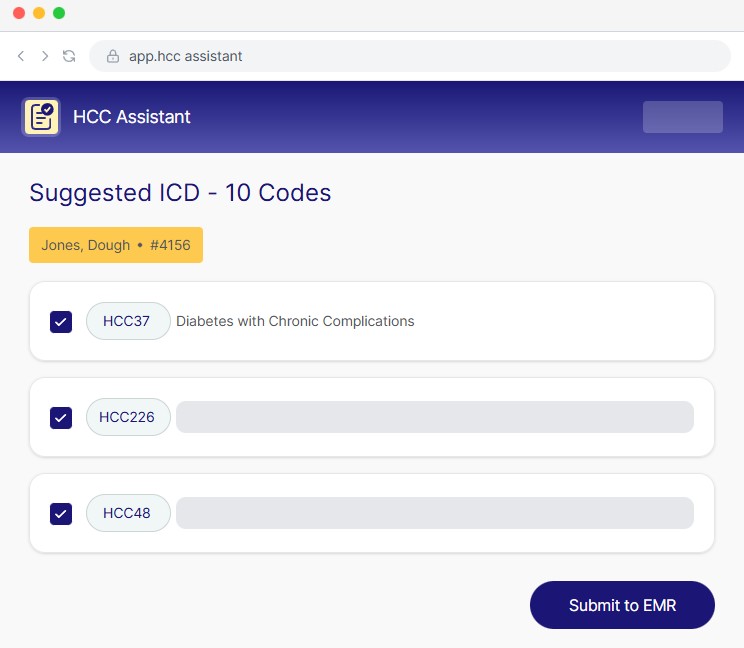
HCC coding software analyzes a patient’s chart to identify and validate the Hierarchical Condition Category (HCC) diagnoses that drive Medicare Advantage risk adjustment.
Inferscience’s HCC Assistant does this in real time inside the EHR — using natural language processing to read structured and unstructured chart data, applying clinical rules to catch overlooked diagnoses, and surfacing HCC code suggestions during the visit. The provider reviews each suggestion and makes the final call on every code.
Why real-time beats the retrospective chart chase
Most HCC coding tools work retrospectively — reviewing charts weeks after the visit, when documentation can no longer be corrected at the source.
Inferscience is prospective. It works inside the note during the encounter, so suggested HCCs are reviewed and documented while the patient is still in the room. That produces more complete, more defensible, MEAT-supported documentation — and it matters more than ever as CMS moves away from unlinked chart review as a submission path.
How it works — three steps, all inside your EHR
What to look for in HCC coding software
Don’t evaluate a coding tool on automation and accuracy alone. The criteria that separate the best HCC coding software in 2026:
EHR integration
Bidirectional, real-time exchange that keeps one source of truth. Inferscience runs natively inside athenaOne, eClinicalWorks, and Epic.
MEAT validation
Every suggested code should trace to documented clinical support (Monitor, Evaluate, Assess, Treat). Inferscience validates to the source.
Human-in-the-loop
Physicians should make the final call on every code. Inferscience suggests; the provider decides.
Audit readiness
A defensible evidence trail for every code so documentation stands up to RADV review.
Point-of-care, not post-visit
Real-time capture during the encounter beats retrospective review after the fact.
Workflow fit
Coding in under 10 minutes, inside the existing workflow — not another system to log into.
Frequently asked questions
What is HCC coding software?
HCC coding software analyzes a patient’s chart to identify and validate the HCC diagnoses that drive Medicare Advantage risk adjustment. HCC Assistant does this in real time inside the EHR, surfacing missed and suspected conditions during the visit so providers can document them at the point of care.
How is real-time HCC coding different from retrospective coding?
Retrospective coding reviews charts after the encounter; prospective, point-of-care coding surfaces diagnoses during the visit while documentation can still be corrected at the source. HCC Assistant is prospective, producing more complete, more defensible, MEAT-supported documentation.
Which EHRs does it integrate with?
HCC Assistant integrates directly with athenaOne, eClinicalWorks, and Epic, and offers an API for payers and third-party vendors.
Does it support the CMS-HCC V28 model?
Yes. HCC Assistant is maintained against the current CMS-HCC V28 model, which reached 100% implementation for payment year 2026.
How accurate is it?
HCC Assistant delivers 98% coding accuracy. Every suggestion comes with an evidence trail, and physicians can reject any code that doesn’t apply.
See HCC Assistant running inside your EHR
Book a strategy call and we’ll show it with your workflow.
Book a Strategy Call